
Dear Julia James Davis,
Much of Romantic poetry and nineteenth-century high prose isn’t profound; it’s inflated, mistaking verbal Inflammation and swelling for intellectual depth and ornament for insight. An ordinary sensation such as boredom, melancholy, lust, resentment, or self-pity is dressed in epithets, dragged through subordinate clauses, and presented as if the author has just discovered a new continent of the human soul. The result is not sophisticated literature; it’s banality.
A large amount of the period is also just bad: cruel, hateful, as in the racial and antisemitic machinery of works such as A Christmas Carol, Trilby, and Dracula; moralizing, vaporous, melodramatic, and in love with its own voice. Romantics and Victorians wrote as if long sentences were evidence of a great thought, and generations of critics/professors then multiply the problem by treating literary/poetic obscurity as depth. It is not. Most of the time obscurity is obscurity, and pomposity is pomposity.
Most of this writing hasn’t aged into wisdom because there was not much wisdom there to begin with. Strip away the antique vocabulary, the clouds, moonlight, ruined abbeys, fainting spells, dying from tuberculosis, sexual hysteria, trembling bosoms, mysterious foreigners, and the sublime proposition underneath is tiny. The problem is the instinct to blame the modern reader for finding these pages unintelligible. Some pages feel unintelligible because they are unintelligible. That isn’t the reader’s failure of education, patience, or sensitivity. Sometimes the literary emperor isn’t wearing complex clothes. He is just butt naked.
Schiller, Carlyle, and Ruskin belong to a culture that confused grandeur of manner with greatness of mind. Carlyle can’t simply say that human beings know very little about the universe. In Sartor Resartus, man must become a fish: “Such a Minnow is Man; his Creek this Planet Earth; his Ocean the immeasurable All.” Then come the tides, trade winds, monsoons, eclipses, Providence, and “Æons of Æons.” The idea is perfectly valid. Human knowledge is limited. But Carlyle cannot simply make the point. He has to fire the cannon through an entire rococo paragraph, in a book that runs to roughly 80,000 words and thirty-three chapters.
Job solves the same problem in one sentence: “Where were you when I laid the foundations of the earth?” There is the whole argument. Human beings are small, their knowledge is partial, and creation exceeds their comprehension. No minnows, no monsoons, no parade of metaphors. God asks one question, and the universe suddenly becomes very large.
And then there is Teufelsdröckh. What in God’s mercy is Teufelsdröckh? Carlyle makes the reader hack through a fictional German professor, Diogenes Teufelsdröckh, whose magnificently intimidating name roughly means “Devil’s shit.” At this point the literary whole enterprise begins to parody itself. Before you can reach the philosophy, you have to get through the costume department. Carlyle takes a perfectly intelligible observation about human limitation, dresses it in German metaphysics, gives it an absurd professor with an absurd name, floods the page with portentous BS imagery, and then challenges a Victorian gentleman, apparently blessed with endless leisure between sermons, club dinners, and his fifth weekly visit to the brothel, to mistake theatrical difficulty for intellectual depth. That is part of the larger Victorian joke: a civilization capable of wrapping vice in velvet and hypocrisy in etiquette could make almost anything look profound. This whole genre is Teufelsdröckh.
There is also a simpler explanation for falling vocabulary scores among college graduates. We sent millions of people to college who once would have entered the trades. So when vocabulary scores among college graduates fall, perhaps civilization has not collapsed. Perhaps “college graduate” no longer means what it meant in 1950s. We turned universities into mass credential factories, gutted vocational schools, saddled everyone with a lifelong debt, and then gasped that the average graduate no longer reads Ruskin for pleasure. The real scandal here is not that the plumber never learned Carlyle. It is that we made him take romantic literature/poetry instead of letting him install a toilet.
So when you keep a glossary for Carlyle, don’t announce that civilization has grown stupid. Ask first whether the sentence earned its weight. Ask whether you’ve met a hard thought or only a hard formulation. A translation of Schiller feels foreign because it is foreign. A Victorian period sentence feels heavy because it was built to feel heavy. Neither fact proves that “our vocabulary has dwindled away.” Surface tension is not evidence of depth. Formulation simplicity is not evidence of shallowness. The useful test is still the same: remove the ornamental words and see what claim remains. If the claim is strong, the ornament was decoration. If it collapses, you were reading vapor.
You won’t save beauty by guarding a verbal throne or by treating 19th-century pomposity as a lost sacred tongue. Some of that tongue was already hollow when it was written. Don’t say the former days were better because their sentences were longer. That is not wisdom.
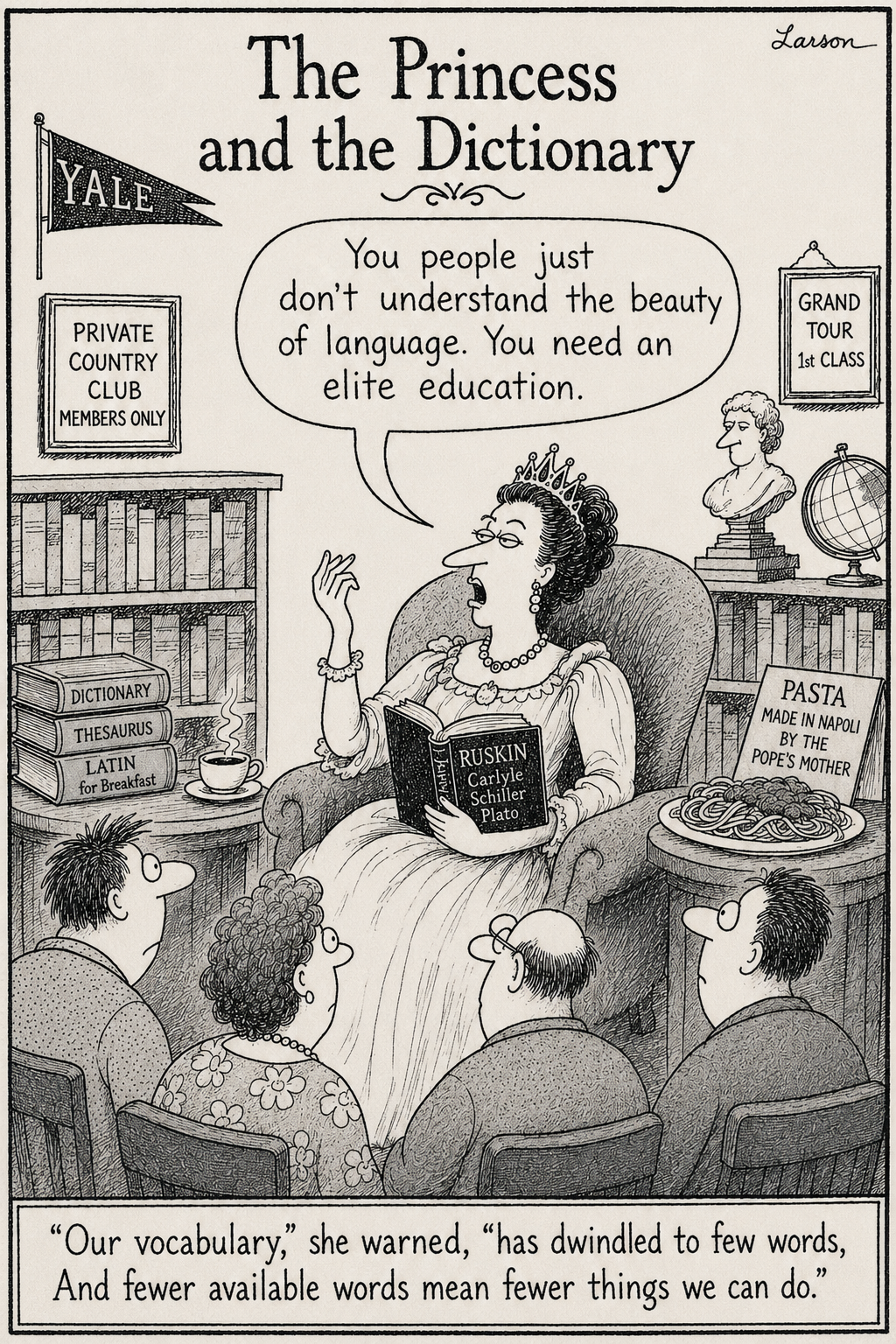
The Princess and the Dictionary
Before an elitist princess made her claim,
She cleared her throat and recited her fame.
She came from the finest preparatory school,
Where Latin was breakfast and Greek was the rule.
Then Yale, where the lawns are impeccably bred,
Where even the squirrels have classics to read.
She learned that good breeding and wisdom align,
Especially if Qatar underwrites the cigars and wine.
She studied old Europe, its manners and art,
And learned that refinement begins in the heart.
For culture, she found, is a delicate thing,
Best handled by people who summer with kings.
You haven’t tasted pasta, not truly, not quite,
Unless the Pope’s mother rolled it by candlelight.
In Napoli, naturally, from wheat blessed by Rome,
Served by Count Luigi XI in his ancestral home.
Well read, well groomed, with an honors degree,
She carried credentials like old French nobility.
“An elite education,” she modestly said,
“Has taught me what civilization had in its head.”
Then Schiller appeared, and disaster began:
Some sentences failed to agree with her plan.
A word she did not know appeared on the page,
And suddenly Western decline took the stage.
She battled through Carlyle with mounting distress,
Where paragraphs failed to provide her success.
If prose could resist someone trained at her school,
The problem, of course, must be language, not rule.
The German Romantic had darkened her tongue,
So civilization itself must be dying young.
Each word that escaped her distinguished degree
Became evidence something was wrong with society.
“Our vocabulary,” she warned, “has dwindled away.
The peasants use fewer expressions today.”
Then Orwell was summoned, his Newspeak was brought,
To prove that plain English had murdered all thought.
Since even a princess with honors degree
Couldn’t read Ruskin with effortless glee,
The West had grown stupid, its language would fall,
Because her private schooling had not taught it all.
But the Bible’s vocabulary is strikingly small,
Yet the prophets and Moses still tower over all.
A handful of words can carry exile and flame,
Covenant, judgment, redemption, and God’s name.
Ecclesiastes answers what gives life its worth,
The Song of Songs sets passion and longing on earth.
Isaiah thunders, consoles, wounds, and inspires,
With a handful of words that set heaven on fire.
Great thought doesn’t need language swollen and vain,
Or pompous sentences like a ceremonial train.
Homer made epic poetry from vocabulary people heard,
Not by awarding an Oxford PhD to every word.
And why should Schiller define the Englishman’s air,
Or German Romantic vocabulary prove wisdom is there?
A translation feels foreign because it is of its kind,
Not because common people have forfeited the mind.
So place the grand resume back on the shelf,
Difficulty sometimes reveals the reader, not the world itself.
You don’t save civilization by guarding a verbal throne,
When Her Highness needs a glossary to read one page alone.
Ecclesiastes already answered the princess with ease:
“Do not say, ‘Why were the former days better than these?’
For it is not from wisdom that you ask this.” At last,
Nothing grows wiser merely by belonging to the past.
References and source
The War on Beauty by Julia James Davis