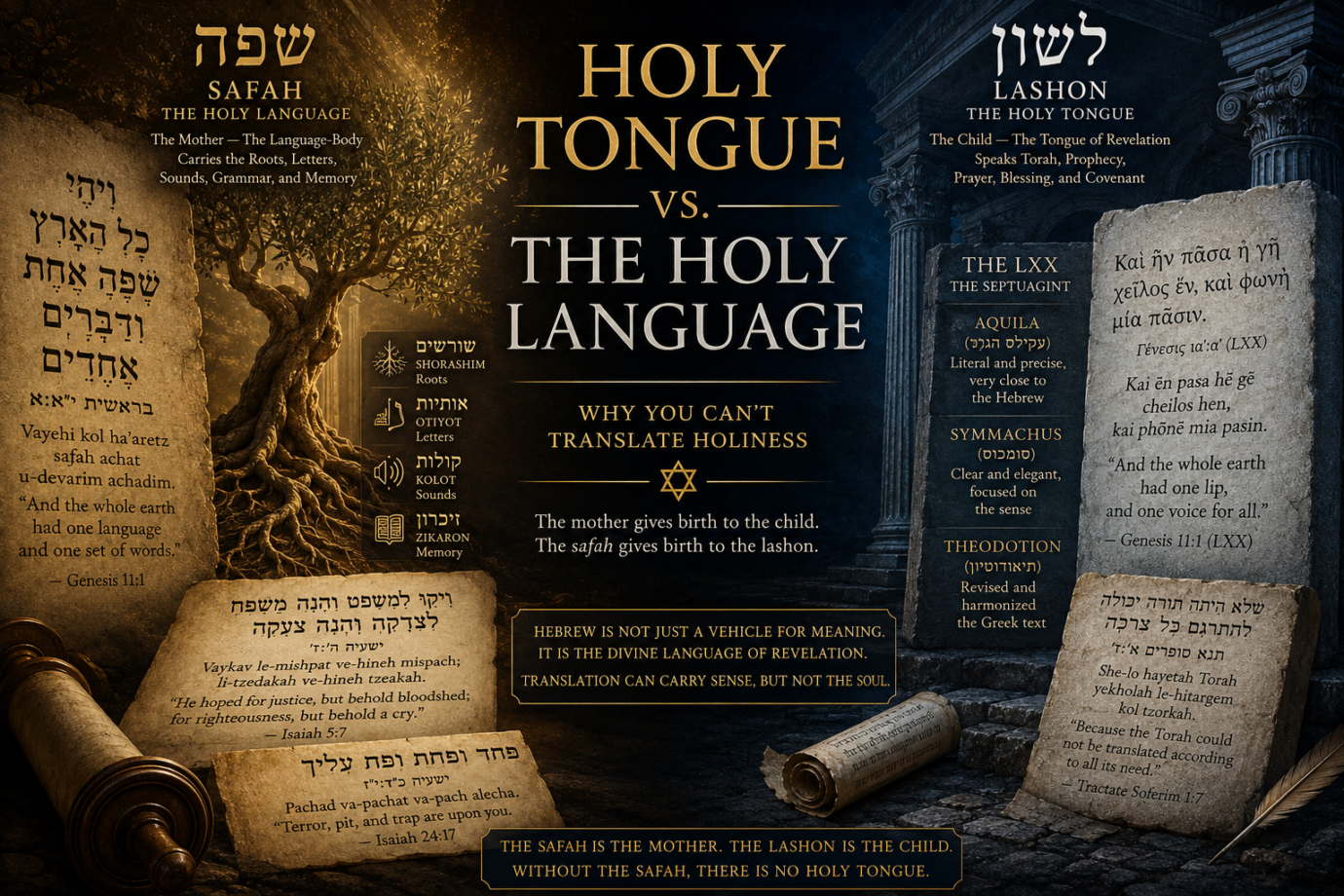
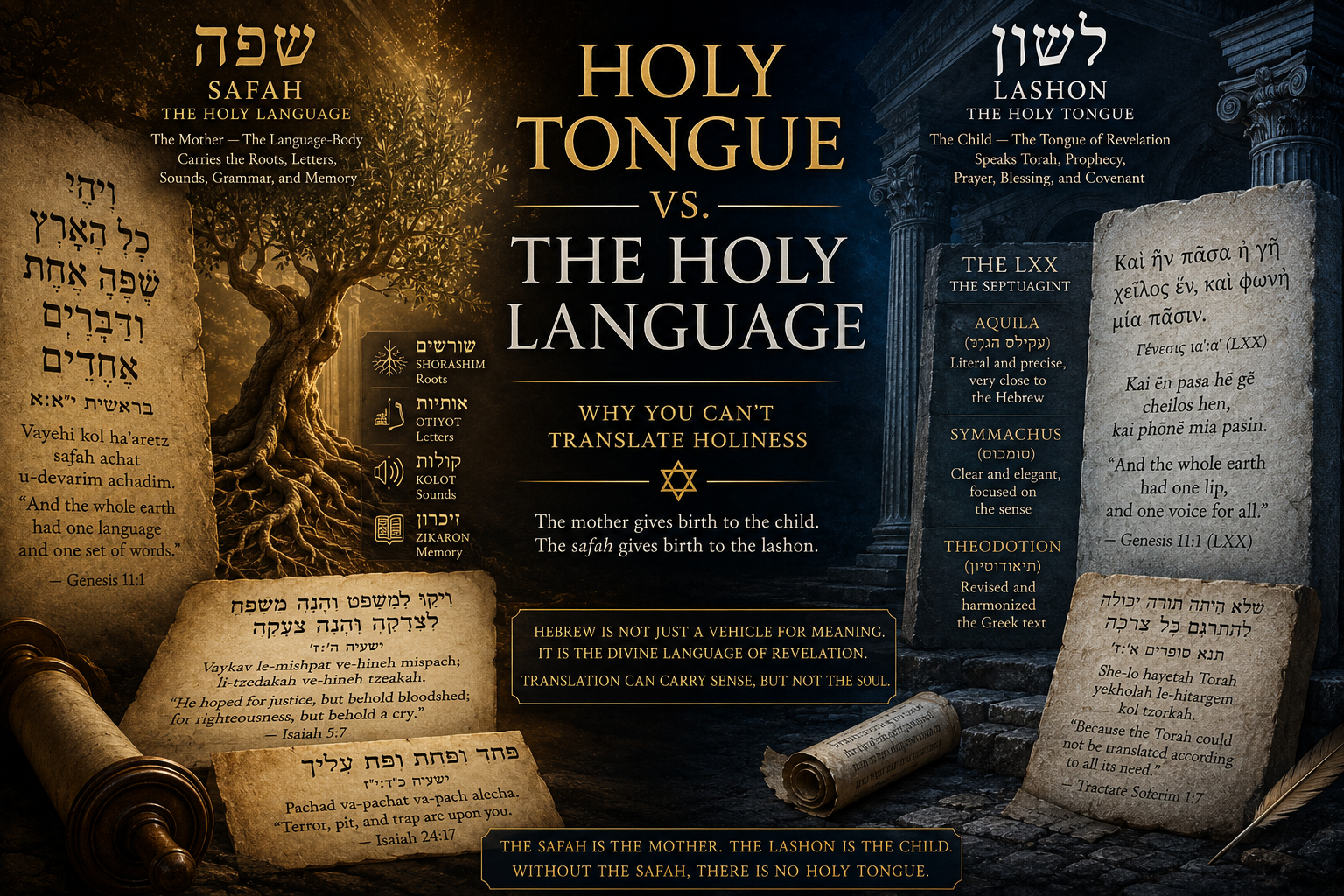
Jewish tradition usually calls Hebrew לשון הקודש — Lashon HaKodesh, the Holy Tongue. That phrase is correct, ancient, and powerful. But it can also hide something important: a tongue does not exist by itself. A tongue needs a body and transmission mechanisms. Sacred speech needs a sacred language system to support it.
That is where the distinction between שפה — safah (language) and לשון — lashon (tongue) matters.
שפה — safah literally means “lip,” and by extension “language.” It is the language-body: vocabulary, grammar, roots, letters, sounds, syntax, idiom, and inherited memory. Genesis says:
ויהי כל הארץ שפה אחת ודברים אחדים
Vayehi kol ha’aretz safah achat u-devarim achadim
“And the whole earth had one language and one set of words.”
— Genesis 11:1
Rashi identifies that original שפה אחת — safah achat as לשון הקודש — Lashon HaKodesh, the holy tongue. That matters because it links the underlying language system, safah, with the sacred tongue, lashon. The tongue is born from the language.
לשון — lashon literally means “tongue,” and by extension “speech,” “utterance,” “idiom,” or “mode of expression.” The Mishnah uses this term when it says:
ואלו נאמרין בלשון הקודש
Ve’elu ne’emarin bi-Lashon HaKodesh
“And these are recited in the holy tongue…”
— Mishnah Sotah 7:2
The Mishnah then lists sacred recitations: the declaration over first fruits, blessings and curses, the priestly blessing, the king’s Torah reading, and other covenantal formulas. In other words, lashon is not merely language as a system. It is language-activated as sacred speech.
So the distinction is simple:
Safah is Hebrew as the holy language-body. Lashon is Hebrew as the holy tongue in motion.The safah is the mother. The lashon is the child. The mother carries and delivers the fetus; without her, no child is born. In the same way, the Hebrew safah carries the letters, roots, sounds, grammar, idioms, and sacred memory. The Hebrew lashon is born from that body as Torah, prophecy, blessing, prayer, judgment, and covenantal speech.
Without the mother, there is no child. Without the safah, there is no lashon.
Ramban gives the classical formulation. He explains that Hebrew is called Lashon HaKodesh because the words of Torah, prophecy, and sacred speech were given through it. Hebrew is not holy merely because Jews use it. It is holy because revelation itself was delivered through this language-body.
This means Hebrew is not just the wrapping paper around revelation. It is part of Revelation’s operating system.
Why Translations Fail
Translation can carry meaning. It can carry instructions. It can carry doctrine. It can even carry beauty. But it cannot carry the full holiness of Hebrew, because holiness in Hebrew is not merely semantic. It is structural.
The Hebrew text works through roots, sounds, letters, spelling, ambiguity, rhythm, word order, and inherited scriptural echoes. These are not decorative extras. They are part of the sacred machinery.
That is why rabbinic tradition is cautious about translation. Tosefta Megillah states:
המתרגם פסוק כצורתו הרי זה בדאי והמוסיף הרי זה מגדף
Ha-metargem pasuk ke-tzurato, harei zeh badai; ve-ha-mosif, harei zeh megadef.
“One who translates a verse literally is a liar; and one who adds to it is a blasphemer.”
— Tosefta Megillah 3:21
That line captures the translator’s trap. Translate too literally, and you distort the meaning. Explain too much, and you import commentary into revelation. Either way, the translation is no longer the original Lashon HaKodesh. It is interpretation.
Isaiah proves the point.
In Isaiah 5:7, the prophet says:
ויקו למשפט והנה משפח לצדקה והנה צעקה
Vaykav le-mishpat ve-hineh mispach; li-tzedakah ve-hineh tzeakah
“He hoped for justice, but behold bloodshed; for righteousness, but behold a cry.”
The device depends on the Hebrew sound:
משפט — mishpat, justice, becomes משפח — mispach, bloodshed.
צדקה — tzedakah, righteousness, becomes צעקה — tzeakah, a cry.
English/Greek/Latin can explain the wordplay, but it cannot perform it. The Hebrew makes moral corruption audible. Justice is twisted into bloodshed. Righteousness becomes a scream. That is not just meaning. That is safah generating lashon. My Isaiah literary-devices article makes this exact point by identifying the Hebrew wordplay and sound similarity in Isaiah 5:7.
The same applies to Isaiah 24:17:
פחד ופחת ופח
Pachad va-pachat va-pach
“Terror, pit, and trap.”
English gives the dictionary meaning. Hebrew gives the blow. Pachad, pachat, pach lands like a hammer. The line works through compression, rhythm, and sound. Translation can say what happened. Hebrew makes it happen.
The same is true of ciphers, palindromes, homographs, rhymes, and word variations. In Isaiah 7:4, the possible אלבם — ALABM cipher depends on Hebrew consonants and Hebrew letter-order. The article notes that טבאל — Tabeel, spelled T-B-L, can be read through a Hebrew substitution pattern to produce R-M-L, possibly pointing toward Remaliah. That mechanism cannot function in English, Greek, or Latin. It is not just a message. It is a Hebrew machine.
That is why translation cannot fully carry holiness. It can describe the machine, but it cannot become the machine.
It’s All Greek to Me
The Greek translation of the Torah is commonly called the Septuagint, or LXX. In Jewish terms, it is תרגום השבעים — Targum Ha-Shiv‘im, the “translation of the seventy,” though technically the tradition describes seventy-two elders, six from each tribe. Greek is יוונית — Yevanit.
Jewish sources do recognize that Greek held a special status. Mishnah Megillah records Rabban Shimon ben Gamliel’s view that sacred scrolls, among foreign languages, were permitted to be written only in Greek:
אף בספרים לא התירו שיכתבו אלא יוונית
Af ba-sefarim lo hitiru she-yikatevu ela Yevanit
“Even with regard to scrolls, they permitted them to be written only in Greek.”
— Mishnah Megillah 1:8
The Bavli explains this through Genesis 9:27: יפת אלהים ליפת וישכן באהלי שם — Yaft Elohim le-Yefet ve-yishkon be’ohalei Shem, read as allowing the beauty of Japheth, meaning Greek, to dwell in the tents of Shem.
But that is a concession, not an identity. Greek may be dignified. Greek may be useful. Greek may even be halakhically permitted in a narrow context. But Greek does not become Lashon HaKodesh.
The rabbinic tradition also preserves a much darker judgment. Tractate Soferim says that when the Torah was translated into Greek for King Ptolemy, the day was as hard for Israel as the day the golden calf was made, because the Torah could not be translated adequately:
שלא היתה תורה יכולה להתרגם כל צרכה
She-lo hayetah Torah yekholah le-hitargem kol tzorkah
“Because the Torah could not be translated according to all its need.”
— Tractate Soferim 1:7
That phrase is the heart of the argument: כל צרכה — kol tzorkah, “all its need,” “its full requirement,” “its complete demand.” Translation may carry part of Torah, but not all that Torah requires. The Hebrew safah contains more than portable meaning. It contains the architecture of holiness.
Aquila, Symmachus, and Theodotion: The Best Greek Still Cannot Become Hebrew
The later Greek translators and revisers tried to solve the problem. עקילס הגר — Akylas ha-ger, Aquila the proselyte, produced an extremely literal Greek rendering of the Hebrew Bible. The Yerushalmi tradition says Aquila translated the Torah before Rabbi Eliezer and Rabbi Yehoshua, and they praised him with the phrase יפיפית מבני אדם — yafyafita mi-bnei adam, “You are fairer than the sons of men.”
That is important. Jewish tradition did not dismiss Aquila as careless. Quite the opposite: it recognized the seriousness of the project. Aquila’s version tried to reproduce the Hebrew “to the most minute detail,” even when doing so strained Greek.
Then came סומכוס — Sumkhos, Symmachus, whose translation was smoother and more elegant Greek. Jewish Encyclopedia describes Symmachus as writing good Greek and trying to reproduce the sense of the Hebrew original clearly.
Then came תיאודוטיון — Te’odotyon, Theodotion, whose version stood somewhere between slavish literalism and freer Greek interpretation.
But all three remain trapped in the same problem.
- Aquila preserves Hebrew form but wounds Greek idiom.
- Symmachus preserves Greek elegance but moves away from Hebrew form.
- Theodotion stands between the two, but still does not become Hebrew.
This is the translation dilemma in miniature. If Greek follows Hebrew too closely, it stops being natural Greek. If Greek becomes elegant Greek, it stops tracking Hebrew’s form. If it compromises, it remains a compromise.
That is why even the best Greek translations can be useful, learned, and impressive, but they cannot become Lashon HaKodesh. They are not born from the Hebrew safah. They are not the mother. They are not the womb. They are not the original body of revelation.
They are mirrors and lenses. Some are polished mirrors. Some are finely ground lenses. But every mirror reverses something, and every lens bends the light. They may reflect Hebrew, magnify Hebrew, or help the reader glimpse Hebrew from a distance. But they also refract, flatten, filter, and distort. None is the face itself. None is the original light meant to enter your eye.
The Final Argument
The Holy Tongue and the Holy Language must be held together. If we speak only of Lashon HaKodesh, someone may imagine that holiness is merely a religious use of any language. Say holy things in English, Greek, Arabic, or Latin, and the speech becomes holy. But that is not the Jewish claim.
The Jewish claim is even stronger. Hebrew itself is the sacred language-body through which Torah, prophecy, commandment, blessing, judgment, and covenant were delivered.
- The lashon is holy because it speaks revelation (e.g., the unity of G-d).
- The Safah is holy because it makes that speech and its transmission possible.
Remove the safah (language), and the lashon (tongue) becomes an orphan. It may still be meaningful. It may still be beautiful. It may still teach, inspire, and guide. But it is no longer the original holy tongue. It is an explanation. It is a commentary. It is a shadow cast by the original flame.
Translation is necessary. Translation opens the door for those who cannot yet enter the Hebrew house. But translation must know its place. It is a guide, not a replacement. It points toward the holy language. It does not become the holy language.
The mistake is thinking that holiness is fully portable. It is not. Holiness can be transmitted, but not fully transferred. It can be explained, but not fully duplicated.
That is why the literary devices of Isaiah matter so much. They prove the theological point in concrete form. Puns, rhymes, ciphers, parallelisms, homographs, and wordplays are not decorative ornaments sprinkled on top of meaning. They are generated by Hebrew itself. They are the bones and nerves of the prophetic body.
Translation can say, “Isaiah made a pun.” Only Hebrew lets you hear it.
Translation can say, “There may be a cipher here.” Only Hebrew lets the letters unlock.
Translation can say, “This line rhymes.” Only Hebrew makes the line strike the ear.
Translation can explain holiness. Hebrew performs it.
So the proper formulation of Safa vs. Lashon is:
שפת הקודש — Safat HaKodesh is the holy mother-language.
לשון הקודש — Lashon HaKodesh is the holy child of utterance.
The mother carries the roots, letters, sounds, grammar, and memory. The child emerges as Torah, prophecy, prayer, blessing, and covenant.
And that is why holiness cannot be translated. It can be described. It can be approximated. It can be carried across in fragments. But the full holiness of Hebrew lives inside Hebrew: in its words, roots, letters, sounds, and sacred memory.
Primary Jewish Sources
The Hebrew Bible. Genesis 11:1; Isaiah 5:7; Isaiah 24:17.
Mishnah. Megillah 1:8; Sotah 7:2.
Tosefta. Megillah 3:21.
Babylonian Talmud. Megillah 9b.
Jerusalem Talmud. Megillah 1:9.
Tractate Soferim. 1:7.
Rashi. Commentary on Genesis 11:1.
Nahmanides [Ramban]. Commentary on Exodus 30:13.
Maimonides [Rambam]. Mishneh Torah, Hilkhot Tefillin, Mezuzah ve-Sefer Torah 1:19.
Secondary and Reference Sources
“Literary Devices in the Book of Isaiah.” The Illustrated Primer, March 25, 2019.
Labendz, Jenny R. “Aquila’s Bible Translation in Late Antiquity: Jewish and Christian Perspectives.” Harvard Theological Review 102, no. 3 (2009): 353–388.
“Septuagint.” In Encyclopaedia Britannica.
“Symmachus.” In Jewish Encyclopedia.
“Theodotion.” In The Cyclopedia of Biblical, Theological, and Ecclesiastical Literature.
Ah, so now God apparently needs a Hebrew keyboard.
This whole argument is just linguistic barrier dressed up as theology. You say “holiness cannot be translated,” which is basically saying that every Jew who prays in English, every Christian who reads the Bible in Greek or Latin, and every non-Hebrew speaker who studies Scripture is spiritually second-class. That is not scholarship. That is tribal branding.
You also quote “one who translates a verse literally is a liar” as if your rabbis were saying translation is impossible. That is absurd. If translation were impossible, why did Jews produce Targumim? Why did the Septuagint exist? Why did the Mishnah allow Greek scrolls? Mishnah Megillah basically proves the opposite of your claim: Greek was acceptable, therefore Greek can carry holiness just fine. But you wave that away because it ruins the argument.
And the Isaiah examples are cherry-picked. Yes, Hebrew has puns. So what? English has puns too. Greek has puns. Latin has puns. Every language has wordplay. Saying “translation cannot reproduce this exact Hebrew sound” is like saying French poetry cannot be translated because the rhyme changes. That does not prove Hebrew is metaphysically holy. It proves poetry is hard to translate. Congratulations, you discovered literature.
The whole “safah is the mother, lashon is the child” metaphor is just poetic overreach. It sounds deep, but it does not prove anything. You are taking normal linguistic categories — language, speech, idiom, sound — and turning them into a mystical machine because it sounds impressive.
Also, the claim that translation is only “commentary” is self-defeating. Your entire article is written mostly in English. So by your own logic, the article cannot carry its own holiness argument. If English can explain why Hebrew is holy, then English is obviously capable of carrying theological truth. If English cannot carry theological truth, then your article refutes itself the moment it starts speaking English.
The real argument here is not “holy tongue vs. holy language.” It is “I like Hebrew, therefore Hebrew is ontologically superior.” Fine. Hebrew is beautiful. Hebrew is ancient. Hebrew matters. But pretending that God’s revelation gets trapped inside consonants, puns, and letter patterns turns Scripture into a linguistic escape room.
So let’s be honest: this is not an argument against translation. It is an argument against letting ordinary people access the text without passing through the approved priesthood of Hebrew specialists. Same old clerical power move, just with better typography.
Dear Dr. Aydin,
My post argued that translation can transmit meaning, doctrine, instruction, and beauty, but cannot fully reproduce the Hebrew system that generates the text’s sound, root-play, ambiguity, rhythm, and sacred literary force. Your response then helpfully translated that argument into something stupider and attacked that instead. In that sense, you have performed a live reenactment of the very problem the article describes.
No, the claim is not that “God needs a Hebrew keyboard.” Cute line, but wrong theology. God doesn’t need peripherals. He writes with “His finger” on stone and communicates through direct prophetic interface.
The problem is not divine hardware. The problem is your cartoon version of the argument. Hebrew Scripture is not a heap of portable meanings that can be poured into any linguistic bucket without loss. It is built from roots, sounds, letters, echoes, idioms, rhythm, ambiguity, and verbal architecture. Translation can describe that machinery. It can point to it. It can annotate it. It can even admire it with binoculars across the street. But it cannot become it.
A translation of Hebrew Scripture is not Hebrew Scripture in another outfit. It is a report about an event that happened inside Hebrew.
You say this is “linguistic gatekeeping.” That is a comforting accusation because it saves you from having to deal with the actual evidence. A music teacher who says Mozart doesn’t sound the same on a kazoo is not gatekeeping music. A chemist who says water is not reproduced by describing H₂O in a poem is not gatekeeping chemistry. A scholar who says Hebrew wordplay cannot be fully replicated in English is not excluding ordinary people from Scripture. He is stating the obvious to people who have mistaken access for equivalence.
You also pretend my post denies the value of translation. It doesn’t. It says translation is necessary. It opens the door. It teaches. It guides. It carries meaning. But the street guide is not the city, a map is not the mountain, and a photograph of fire does not warm the room. That distinction is apparently too oppressive for the modern reader, who believes that every approximation must be declared identical so nobody’s feelings get hurt.
The Targumim do not refute the argument. They prove it. They exist because translation is needed, and they are called translation because they are not the original. The Septuagint does not refute the argument either. It proves the same thing in Greek robes. Jewish tradition could recognize Greek as dignified and useful while still refusing to confuse it with Lashon HaKodesh. A concession is not an identity. A mirror is not a face. A lens is not the light.
Your “every language has puns” objection is especially impressive because it manages to be both true and irrelevant. Yes, English has puns. Greek has puns. Latin has puns. Nobody denied this. The point is not that only Hebrew can make wordplay. The point is that Hebrew wordplay in Hebrew Scripture is generated by Hebrew itself. Isaiah’s justice becoming bloodshed and righteousness becoming a cry is not a detachable decoration. It is the prophetic blow landing through Hebrew sound. English can tell you that the blow happened. Hebrew lets you hear the strike.
Calling this “poetic overreach” is another way of saying, “I noticed the metaphor but missed the mechanism.” Safah and lashon are not being used as mystical glitter. They describe the difference between a language system and sacred speech in motion. The language-body carries the roots, sounds, grammar, letters, and memory. The tongue gives them utterance. You may dislike the image of mother and child, but disliking a metaphor is not the same as disproving it. It is merely criticism by aesthetic allergy.
Then comes the self-refuting flourish: “Your article is in English, therefore English can carry the argument.” Yes. Correct. English can carry the argument about Hebrew. That is not the same thing as English becoming Hebrew. A museum label can explain a Rembrandt. It does not thereby become the painting. A medical chart can describe a heartbeat. It does not thereby become a living heart. This is not complicated, unless one is determined to confuse explanation with embodiment.
The accusation that this is “clerical power” is the laziest part of the response. When someone cannot answer philology, he reaches for sociology. When he cannot answer evidence, he reaches for motive. When he cannot answer the text, he accuses the text’s defender of wanting a priesthood. It is the standard modern ritual: declare expertise oppressive, flatten the subject, and then congratulate yourself for democratizing what you have just misunderstood.
My post doesn’t say ordinary readers are second-class. It says the original is the source. That should not be controversial. But we live in an age where hierarchy of knowledge is treated as moral violence, and where saying “you lose something in translation” is apparently one goose-step away from tyranny.
So let me simplify it for you.
Translation is not fake. Translation is not useless. Translation is not spiritually worthless. Translation is the doorway. But the doorway is not the house.
The Hebrew Bible is not merely a message that happened to arrive in Hebrew. It is a textual body formed in Hebrew, through Hebrew, and by Hebrew. Its roots, sounds, silences, fractures, repetitions, ambiguities, and echoes are part of its meaning. To deny that is not humility before Scripture. It is the arrogance of the tourist who thinks the postcard is the exotic location.
Your response did not refute the article. It illustrated it. You took a Hebrew argument about the limits of translation, translated it into a crude English (or rather Turkish) caricature, stripped away the structure, flattened the distinctions, added motives never stated, and then announced victory over the polemic you invented.
You proved the thesis. Beautifully and with the confidence of a man applauding himself for missing the train.
That said, Dr. Aydin, we are not really arguing about translation. We are arguing about the premise. My post assumes the traditional Jewish claim that Hebrew is not just another language, but the sacred vessel of revelation. You are free to reject that. You are free to say, “I do not believe Hebrew is holy and neither is the Hebrew Bible.” Fine. Nobody is forcing you into the covenant at swordpoint.
But then at least have the honesty to admit what you are rejecting. Even your own adapted Qur’an, in the Arabic you presumably still regard as superior to translation, repeatedly treats the Torah as divinely revealed. Not as Jewish folklore. Not as tribal branding. Not as a clerical power grab. Revelation.
So the comedy here is rich. You reject the Jewish claim about the Hebrew vessel of Torah, while standing inside a later religious tradition that had to borrow the authority of that same Torah in order to establish its own prophetic chain. Even through the fog of Turkish translation.
And your credentials make this worse, not better. You are not some random internet heckler. You have a Ph.D. in the History of Philosophy. You taught theology, ethics, politics, and religion. You served as dean of a Faculty of Theology.
And this brings us to the obvious question. You do not even read Hebrew, do you? Not “I know a few synagogue words.” Not “I once assaulted a lexicon.” I mean read Hebrew. Follow the roots. Hear the sound-play. See why mishpat becoming mispach, and tzedakah becoming tzeakah, is not decorative punning but the prophetic argument itself detonating inside the language.