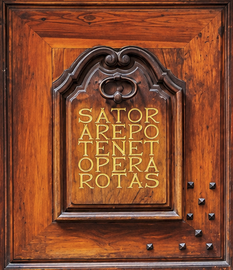
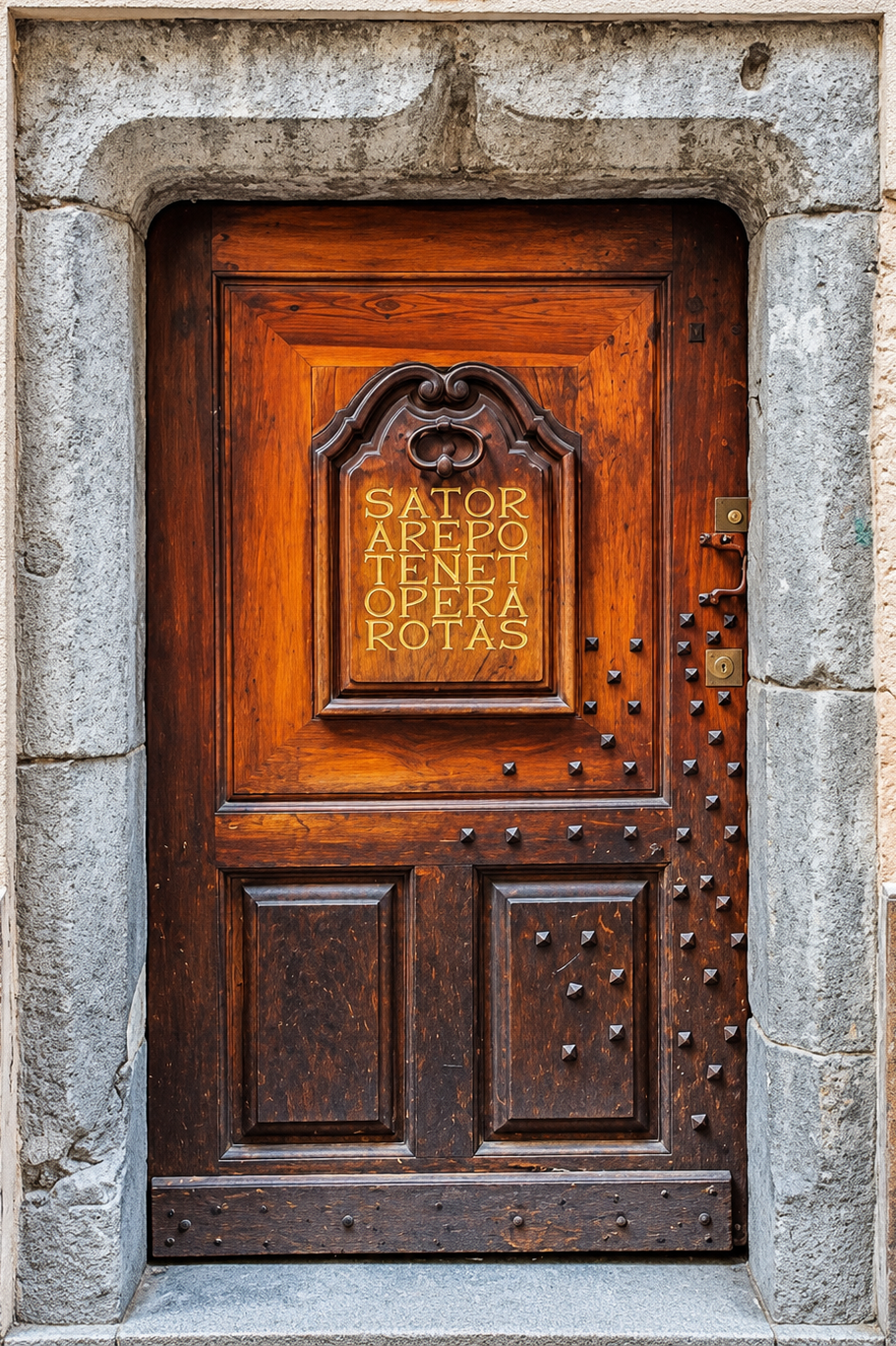
Generations of scholars have been writing about the Sator Square, so I figured I might as well throw my hat into the ring. There is, admittedly, not much empty floor left. Classicists, archaeologists, theologians, cryptographers, mathematicians, historians of religion, Celtic philologists, Egyptologists, students of Jewish mysticism, and the occasional enthusiast armed with gematria and too much free time have all taken a swing at it. Christianity has claimed it. Judaism has claimed it. Stoicism has been called in for questioning. Harpocrates has somehow wandered into the room. So have ploughs, wheels, magical charms, the Lord’s Prayer, Alpha and Omega, and the bronze serpent. And then there is Rose Mary Sheldon, whose sharp treatment of the puzzle manages the rare trick of being both deeply learned and genuinely funny. Her contribution to the menagerie is one of my favorites: APATOR NERO EST, a perfectly respectable-looking anagram that leaves us contemplating, among other absurdities, a fatherless Nero. Sheldon’s point is not frivolous; it is methodological. Give intelligent people twenty-five letters and two thousand years, and eventually somebody will find just about anything in them. After all that attention, the Sator Square has accumulated enough bibliography to require its own branch of the New York Public Library.
The object responsible for all this is absurdly compact:
SATOR
AREPO
TENET
OPERA
ROTAS
Or, in the orientation of the earliest complete Pompeian example:
ROTAS
OPERA
TENET
AREPO
SATOR
Twenty-five letters. Five words. Read the rows from either direction and the same sequence returns. Read the columns and the rows reappear. Rotate the whole thing 180 degrees and it survives intact. At the center sits a single N, crossed horizontally and vertically by TENET, itself a palindrome. It is an elegant little machine, which may explain why so many people have assumed that an elegant secret must be hidden inside it.
The trouble is that sufficiently clever investigators can make twenty-five letters confess to a great many things. The Sator Square has therefore suffered from the intellectual equivalent of an overenthusiastic interrogation. Rearrange the letters long enough and Christianity emerges. Rearrange them differently and Nero appears. Add numerical values and biblical objects begin walking into the room. Translate one word through another language and an Egyptian god politely introduces himself.
That does not mean these observations are worthless. Some are genuinely ingenious, and a few may preserve ancient secondary interpretations. But they are not all answering the same question. There is a fundamental difference between asking what later readers could find in the square and asking how the square itself was originally built.
That distinction is the starting point here.
Rather than beginning with PATER NOSTER, Alpha and Omega, Aleph and Tav, Harpocrates, or a lost Celtic plough, I want to begin with the letters where the ancient writer actually put them. Before decoding the square, we should examine its machinery. Which words reverse into which? Which letters are forced by the geometry? Which choices remain free? What happens when we compare it with other Roman word squares? And, most importantly, does the structure itself contain a coherent semantic statement before anybody starts scrambling the pieces?
Once the problem is approached that way, the square becomes considerably less mystical and, in my view, considerably more interesting.
1. Start With the Artifact
The earliest complete example comes from Pompeii, where the square appears in ROTAS-first orientation on a column of the Palestra Grande. The Ancient Graffiti Project catalogs it as a wordplay or “magic square.” Its archaeological context places the inscription before the destruction of Pompeii in 79 CE, and associated evidence has often been used to argue for a date before the earthquake of 62 CE.[1] The importance of that chronology is obvious. Whatever the square originally meant, it existed very early in the Roman imperial period, before the later Christian uses that would eventually become attached to it.
The early orientation also matters. We habitually call the object the “Sator Square,” but ancient specimens frequently begin with ROTAS. Duncan Fishwick therefore spoke more cautiously of the Rotas-Sator square and distinguished an earlier ROTAS form from the later SATOR orientation.[2] That alone should make us wary of interpretations that assume an ancient observer naturally began at SATOR and immediately encountered “the Creator.”
The square has no natural top. Rotate it 180 degrees and SATOR becomes ROTAS while the object remains unchanged. The modern choice to print SATOR first is convenient, but convenience is not evidence.
2. The Problem Called AREPO
The conventional translation usually comes out something like “The sower Arepo holds the wheels with care.” Grammatically, one can make it work. Semantically, it has the air of a sentence composed during a severe fever attack.
The main offender is AREPO.
No ordinary Latin word arepo is independently attested. Scholars have consequently spent more than a century trying to find it a passport. It has been made Celtic, Greek, Egyptian, Hebrew, Aramaic, a personal name, an agricultural implement, and several other things besides. Fishwick surveyed many of these attempts and pointed to the more obvious structural fact: AREPO is simply OPERA written backward.[2]
That observation deserves more weight than it usually receives because the complete square consists of three reversal relationships:
SATOR ↔ ROTAS
OPERA ↔ AREPO
TENET ↔ TENET
Seen this way, AREPO may not require an independent etymology at all. It may exist because OPERA had to reverse into something. This does not prove that AREPO was meaningless to every ancient reader. A foreign-language pun could have been noticed later, or even deliberately exploited. It does mean, however, that the square can account for AREPO without inventing a lost vocabulary.
That is an important methodological gain. A good solution should make mysteries disappear, not create three new languages in order to save one word.
3. Pompeii Supplies a Control
The idea that the Sator Square was first and foremost sophisticated Roman wordplay becomes much less speculative when we look around Pompeii.
Another Pompeian inscription gives us:
ROMA
OLIM
MILO
AMOR
The Ancient Graffiti Project identifies it as a multidirectional word square. ROMA reverses into AMOR, while the inner lines reverse into one another.[3] Whatever interpretation one prefers for the middle letters, the artifact establishes that Pompeians played with precisely this kind of reversible verbal architecture.
That is our control experiment.
The Sator Square did not descend into a culture that had never seen letters behave this way. Roman writers were already amusing themselves with reversals, palindromes, and word squares. The question is therefore not whether the Sator Square belongs to the family of Roman wordplay. It plainly does. The more interesting question is why this particular example proved so much more durable than the others.
One possibility is that it did something the ordinary examples did not. It did not merely reverse elegantly. It also almost said something.
4. Sheldon, Nero, and the Perils of Finding What You Seek
Sheldon provided one of the best demonstrations of how easily the square rewards an obsessive decoder. In her 2003 survey, “The Sator Rebus: An Unsolved Cryptogram?,” she catalogued the extraordinary variety of interpretations generated from these twenty-five letters.[4] One of her favorites was:
APATOR NERO EST
The Greek apator means “fatherless” or “without a father,” so the mixed Greek-Latin expression can be made into the mischievous suggestion that Nero lacked a human father, hence the later shorthand that the emperor had somehow acquired a virgin birth.[4]
The joke becomes considerably funnier when the letters are counted. APATOR NERO EST contains exactly half the number of every even-frequency letter in the Sator Square, while containing its single N. Better still, that N occupies the center of the thirteen-letter phrase. Two copies of APATOR NERO EST can therefore be crossed on their shared N and consume all twenty-five letters of the square exactly.
That arrangement leaves nothing behind. The famous PATER NOSTER reconstruction, by contrast, leaves AAOO, which must then be interpreted as Alpha and Omega.
By that narrow combinatorial measure, Sheldon’s Nero joke is actually cleaner.
No sensible person should conclude that Nero is therefore the hidden key to the Sator Square. That is precisely why the example is so useful. It demonstrates the danger of treating a successful anagram as evidence of original intent. A beautiful rearrangement may tell us more about the ingenuity of the rearranger than about the person who scratched the original letters into plaster.
Paul Veyne made essentially the same methodological point decades earlier. He criticized attempts to calculate the improbability of the PATER NOSTER arrangement as though investigators had specified that target before examining the square. They had not. They searched the letters, found an impressive result, and then treated its apparent improbability as evidence that it must have been intended.[5] That is backwards probability.
Once Sheldon can summon Nero from the same inventory, PATER NOSTER is still clever, but it is no longer privileged merely because it is clever.
5. PATER NOSTER and the Christian Solution
The PATER NOSTER reconstruction nevertheless deserves respect. Two copies of PATER NOSTER can be crossed at their shared N, leaving two As and two Os. These are conventionally read as Alpha and Omega, producing an elegant Christian design. Orcibal discusses precisely this construction and the related cross formed by the intersecting TENETs.[6]
The problem is not that the pattern is imaginary. The pattern is real.
The problem is that it does not explain the artifact’s original geometry.
To reach PATER NOSTER one must dismantle the square, disregard the positions in which the letters were actually written, and create a new cruciform arrangement. That procedure can identify a secondary reading, but it cannot by itself explain why the original author placed S in one corner, N in the center, or AREPO beneath SATOR.
This is where chronology compounds the difficulty. The Pompeian square is securely first-century, whereas explicit Christian appropriation of the object is much easier to demonstrate later. Fishwick regarded the early Pompeian evidence as a serious difficulty for the straightforward Christian-cryptogram theory.[2] Veyne went further and regarded the entire PATER NOSTER argument as an exercise in probabilistic overconfidence.[5]
The most economical conclusion is not that Christians never saw PATER NOSTER in the square. They very plausibly did. It is that discovering a Christian pattern later is not the same as demonstrating Christian authorship earlier.
6. Reduce the Machine to Three Words
If the square is examined without rearranging anything, a simpler structure emerges:
SATOR
OPERA
TENET
The other two forms arise automatically through reversal:
SATOR → ROTAS
OPERA → AREPO
TENET → TENET
The Latin is suggestive.
Sator means a sower, but classical usage extends naturally to “begetter,” “father,” or “originator,” including elevated and divine contexts. Opera can mean “works,” the plural of opus. Tenet is the ordinary third-person singular of teneo: “holds,” “keeps,” “possesses,” or “maintains.”
The resulting sequence:
SATOR OPERA TENET
can therefore be read quite naturally as: The originator holds the works. “The Creator sustains his works” is a reasonable interpretive paraphrase, but it should be identified as such. The Latin does not explicitly supply “his,” and opera need not carry the full theological freight of “creation.”
The three-word reading itself is not new. Earlier interpreters reached SATOR OPERA TENET through boustrophedon readings of the square, although they differed sharply over what it meant and whether that reading reflected the square’s original construction. What matters here is not claiming the phrase as a new decipherment, but asking whether its semantic coherence helps explain the lexical choices that produced the square.
More importantly, I have not found evidence that SATOR OPERA TENET circulated as a fixed Latin maxim. The argument does not require one. What matters is whether these particular words were deliberately chosen because they produce both structural elegance and semantic coherence.
That is where the center becomes intriguing.
7. TENET Was Chosen, Not Forced
It is tempting to marvel that TENET sits in the center and reads identically in either direction. But any 5 x 5 square with the same symmetry requires a palindromic central row. The palindrome itself is therefore not the miracle.
The choice of palindrome may be.
Once SATOR is placed on the outside and OPERA is inserted into the corresponding inner position, the geometry constrains the central word to:
TE?ET
The middle letter remains free.
Jean Orcibal was already examining these lexical possibilities in 1954.[6] Charles Douglas Gunn later turned the problem into a substantial computational investigation in his 610-page Yale dissertation, The Sator-Arepo Palindrome: A New Inquiry Into the Composition of an Ancient Word Square.[7]
Several Latin forms can satisfy the pattern. TENET is therefore not mathematically inevitable. Yet TENET has an extraordinary advantage over its competitors: it gives the emerging sequence an ordinary, present-tense semantic relation.
SATOR OPERA TENET
The originator holds the works.
And then the pun becomes visual:
T
E
T E N E T
E
T
The word meaning “holds” occupies the invariant cross that holds the square together. That is the strongest evidence, in my view, for semantic and geometric co-design. Geometry demanded a palindrome. It did not demand that the palindrome mean “holds.” Someone chose N.
8. Gunn’s Computer and the Wrong Question About Uniqueness
Gunn’s 1969 dissertation is important because he approached the square as a constrained construction problem rather than merely as a theological cryptogram.[7] Later summaries report that his computer generated large numbers of formally possible Latin squares, and one often encounters the figure 2,264. Until the dissertation itself is checked page by page, that exact figure should remain provisional rather than being repeated as sacred numerology of a more modern sort.
The larger methodological lesson, however, is secure. The Sator Square is not impressive merely because creating a symmetrical 5 x 5 object is difficult. Other formal solutions are possible.
The better question is why this one survived.
If many geometrically acceptable squares can be built, then the interesting variable becomes semantic fitness under constraint. SATOR reverses into the meaningful ROTAS. OPERA is a common Latin word whose reversal supplies the structurally necessary AREPO. The geometry then creates TE?ET, and TENET supplies an ordinary verb that binds the two meaningful terms into a comprehensible proposition.
That is more persuasive than claiming mathematical uniqueness. It looks like optimization.
The inventor did not necessarily begin with a philosophical creed and then encode it. He may have started with a promising reversal pair, experimented with compatible words, and discovered that one combination gave him both a perfect square and a sentence worth remembering. Design often works that way. Form and meaning meet somewhere in the middle and then pretend they planned the date from the beginning.
9. The Philosophical Language Was Already in the Air
If SATOR OPERA TENET carries a cosmological overtone, nothing in it requires Christianity.
Cicero supplies a remarkably close conceptual parallel in De natura deorum 2.86. His Stoic speaker calls the cosmos seminator et sator et parens, the producer, sower, and parent of all things, and then says that it nourishes and continet, holds or contains, its parts.[8] That is not the Sator Square, but it demonstrates that SATOR plus generation plus cosmic maintenance was perfectly at home in pre-Christian Latin philosophical discourse.
The Greek tradition reaches even farther back. Xenophon has Socrates speak of the unseen divine power whose works reveal it, especially the one who “orders and holds together the universe.” The passage explicitly juxtaposes the gods’ erga, their works, with the cosmic principle that keeps the whole in order.[9]
Hellenistic Jewish literature later speaks the same philosophical language. Wisdom of Solomon 1:7 describes the divine Spirit as that which “holds all things together,” using to synechon ta panta, language widely recognized as participating in the surrounding Greek philosophical vocabulary.[10]
None of this proves that a Stoic philosopher designed the square, still less that Cicero supplied its source text. It establishes something more modest and more useful: “originator, works, holds together” is not a theological idea imported backward from Christianity. It belongs naturally to the intellectual environment in which the square first appears.
10. Harpocrates: A Good Pun Should Know Its Place
AREPO has attracted one particularly ingenious alternative. Miroslav Marcovich proposed that the form could reflect Greek-Egyptian names associated with Harpocrates, and Gerald Browne followed with a brief note provocatively titled “Arepotenet = Harpocrates.”[11] Browne’s idea exploits the possibility of bilingual Greek-Latin wordplay around AREPO and the Greek semantic equivalent of TENET.
This is much more interesting than the old attempt to make AREPO a mysterious Celtic plough, because Harpocrates genuinely belonged to the Greco-Egyptian religious world familiar in Roman Italy. It also has the advantage of working with the letters in place rather than scrambling the entire square.
But the same evidentiary rule still applies. OPERA → AREPO is mechanically demonstrable. AREPO → Harpocrates is interpretive.
The Harpocrates proposal is therefore best treated as a possible secondary bilingual payoff. It may help explain why AREPO did not look as nonsensical to every ancient reader as it does to us. It does not need to carry the burden of explaining the square’s construction.
A clever pun should be allowed to remain a clever pun. Not every guest needs to be promoted to a master architect.
11. Jewish Readings, Aleph-Tav, and Vinel
The same restraint applies to Jewish interpretations.
The Hebrew conceptual equivalent of Alpha and Omega is obvious enough: Aleph to Tav, first letter to last, a natural expression of completeness. Biblical language such as “I am the first and I am the last” gives that first-to-last theology a pre-Christian Jewish pedigree.
But the Sator Square does not visibly contain Aleph and Tav. The familiar A/O pair appears only after the PATER NOSTER rearrangement. Aleph-Tav is therefore a legitimate comparative idea, but at present it does not explain the mechanics of the square.
Nicolas Vinel has proposed a much more elaborate Jewish solution, arguing that mathematical transformations expose references to the bronze altar of Exodus 27 and the bronze serpent of Numbers 21.[12] Vinel’s theory is serious enough to deserve engagement and imaginative enough to be enjoyable, but it requires several additional operations before the supposed message appears.
That transformation cost matters.
A theory requiring fewer discretionary moves should receive priority over one requiring more, particularly when both are trying to explain the same twenty-five letters. The basic reversal structure of SATOR, OPERA, and TENET is visible without arithmetic, gematria, translation, or letter rearrangement.
The Jewish layer may still be real as reception history or secondary interpretation. It simply does not need to be the foundation.
12. What the Square Probably Is
After all the theological smoke has cleared, the strongest reconstruction is almost disappointingly elegant.
The Sator Square appears first to be an exceptionally successful Roman word square built through reversible lexical pairs:
SATOR ↔ ROTAS
OPERA ↔ AREPO
TENET ↔ TENET
Within that structure sits a plausible semantic kernel:
SATOR OPERA TENET
“The originator holds the works.”
The sentence is not a known quotation. It does not require us to identify the author as Stoic, Christian, Jewish, Pythagorean, or Isiac. Its vocabulary nevertheless sits comfortably inside a pre-Christian Mediterranean philosophical world in which divine or cosmic principles generate, order, maintain, and hold the universe together.
The square’s brilliance is that the semantics and mechanics reinforce one another. SATOR supplies a meaningful outer word whose reversal is also meaningful. OPERA supplies the semantic object while generating the otherwise troublesome AREPO. Those choices constrain the center to TE?ET. Of the possibilities available, TENET gives the cleanest proposition and simultaneously describes what the middle of the square is visibly doing.
That looks less like decoding a secret message than reconstructing a design decision.
And that may be as close as we are likely to get to the workshop.
Conclusion: It Holds
The Sator Square has survived partly because it invites people to find more in it than its maker needed to put there.
Christians found the Lord’s Prayer and Alpha and Omega. Jewish interpreters found biblical and numerical correspondences. Egyptologists heard Harpocrates. Magicians turned the words into charms. Sheldon produced Nero without a father, largely to remind everyone how accommodating twenty-five letters can become once rearrangement begins.
Those readings belong to the history of the object. They should not automatically be confused with its manufacture.
If we instead privilege the original geometry, a simpler picture emerges. The square belongs to a Roman culture that demonstrably enjoyed reversible verbal constructions. Its awkward AREPO is naturally explained as OPERA reversed. Its center was not forced to be TENET, yet TENET was selected. And the resulting meaningful sequence, SATOR OPERA TENET, gives us a compact statement whose central verb also describes the mechanism that carries it.
After generations of increasingly elaborate attempts to force the Sator Square to confess, perhaps the best joke has been sitting at its center all along.
TENET means “it holds.”
And, annoyingly enough, it does.
Sources and References
[1] Ancient Graffiti Project, CIL IV 8623, Pompeii, Palestra Grande, ROTAS/OPERA/TENET/AREPO/SATOR. The Pompeian specimen is the central archaeological datum for the early chronology of the square.
[2] Duncan Fishwick, “An Early Christian Cryptogram?” CCHA Report 26 (1959): 29–41. Fishwick reviews the ROTAS and SATOR orientations, early finds, AREPO theories, PATER NOSTER, and the Christian-origin debate.
[3] Ancient Graffiti Project, CIL IV 8297, Pompeii, the ROMA/OLIM/MILO/AMOR word square. It provides an important contemporary control for reversible Roman wordplay.
[4] Rose Mary Sheldon, “The Sator Rebus: An Unsolved Cryptogram?” Cryptologia 27, no. 3 (2003): 233–287. Sheldon surveys the extraordinary number of religious, magical, linguistic, and cryptographic solutions proposed for the square.
[5] Paul Veyne, “Le carré Sator ou beaucoup de bruit pour rien,” Bulletin de l’Association Guillaume Budé: Lettres d’humanité, no. 27 (1968): 427–460. Veyne attacks the probability reasoning used to argue that the PATER NOSTER anagram could not be accidental.
[6] Jean Orcibal, “‘Dei agricultura’: le carré magique SATOR AREPO, sa valeur et son origine,” Revue de l’histoire des religions 146, no. 1 (1954): 51–66. Orcibal discusses the Christian interpretations, the TENET cross, lexical possibilities, and competing explanations of the square.
[7] Charles Douglas Gunn, The Sator-Arepo Palindrome: A New Inquiry Into the Composition of an Ancient Word Square (PhD diss., Yale University, 1969). The dissertation runs approximately 610 pages and represents the major early computational attack on the problem. The exact numerical totals attributed to Gunn in later literature should be checked directly against the dissertation before quotation.
[8] Cicero, De natura deorum 2.86: seminator et sator et parens … omniaque sicut membra et partes suas nutricatur et continet. The passage provides a close pre-Christian conceptual parallel for a generative sator that holds or contains what proceeds from it.
[9] Xenophon, Memorabilia 4.3.13, where Socrates points to the gods’ erga and especially to the unseen power that orders and holds together the universe.
[10] Wisdom of Solomon 1:7, to synechon ta panta, “that which holds all things together.” Modern commentary explicitly recognizes the relationship of this language to Greek philosophical, especially Stoic, cosmological vocabulary.
[11] Miroslav Marcovich, “Sator arepo = ΓΕΩΡΓΟΣ ἉΡΠΟΝ … Harpo(crates),” Zeitschrift für Papyrologie und Epigraphik 50 (1983): 155–171; Gerald M. Browne, “Arepotenet = Harpocrates,” Zeitschrift für Papyrologie und Epigraphik 52 (1983): 60.
[12] Nicolas Vinel, “Le judaïsme caché du carré Sator de Pompéi,” Revue de l’histoire des religions 223, no. 2 (2006): 173–194. Vinel argues for a Jewish cryptogram involving Pythagorean numerical structures, the bronze altar, and the bronze serpent.
Links and Related Reading
Rose Mary Sheldon, “The Sator Rebus: An Unsolved Cryptogram?” Cryptologia article
Duncan Fishwick, “An Early Christian Cryptogram?” Full article
Paul Veyne, “Le carré Sator ou beaucoup de bruit pour rien.” Persée edition
Jean Orcibal, “‘Dei agricultura’: le carré magique SATOR AREPO, sa valeur et son origine.” Persée edition
Nicolas Vinel, “Le judaïsme caché du carré Sator de Pompéi.” Article record
Miroslav Marcovich, “Sator arepo = … Harpo(crates).” JSTOR volume record
Gerald M. Browne, “Arepotenet = Harpocrates.” JSTOR volume record
Cicero, De natura deorum 2.86–88. Latin text
Xenophon, Memorabilia 4.3.13–14. Greek and contextual text
Charles Douglas Gunn, The Sator-Arepo Palindrome: A New Inquiry Into the Composition of an Ancient Word Square (Yale University, 1969). The full dissertation remains the most important source still worth obtaining for a page-level reconstruction of his computational experiment.