



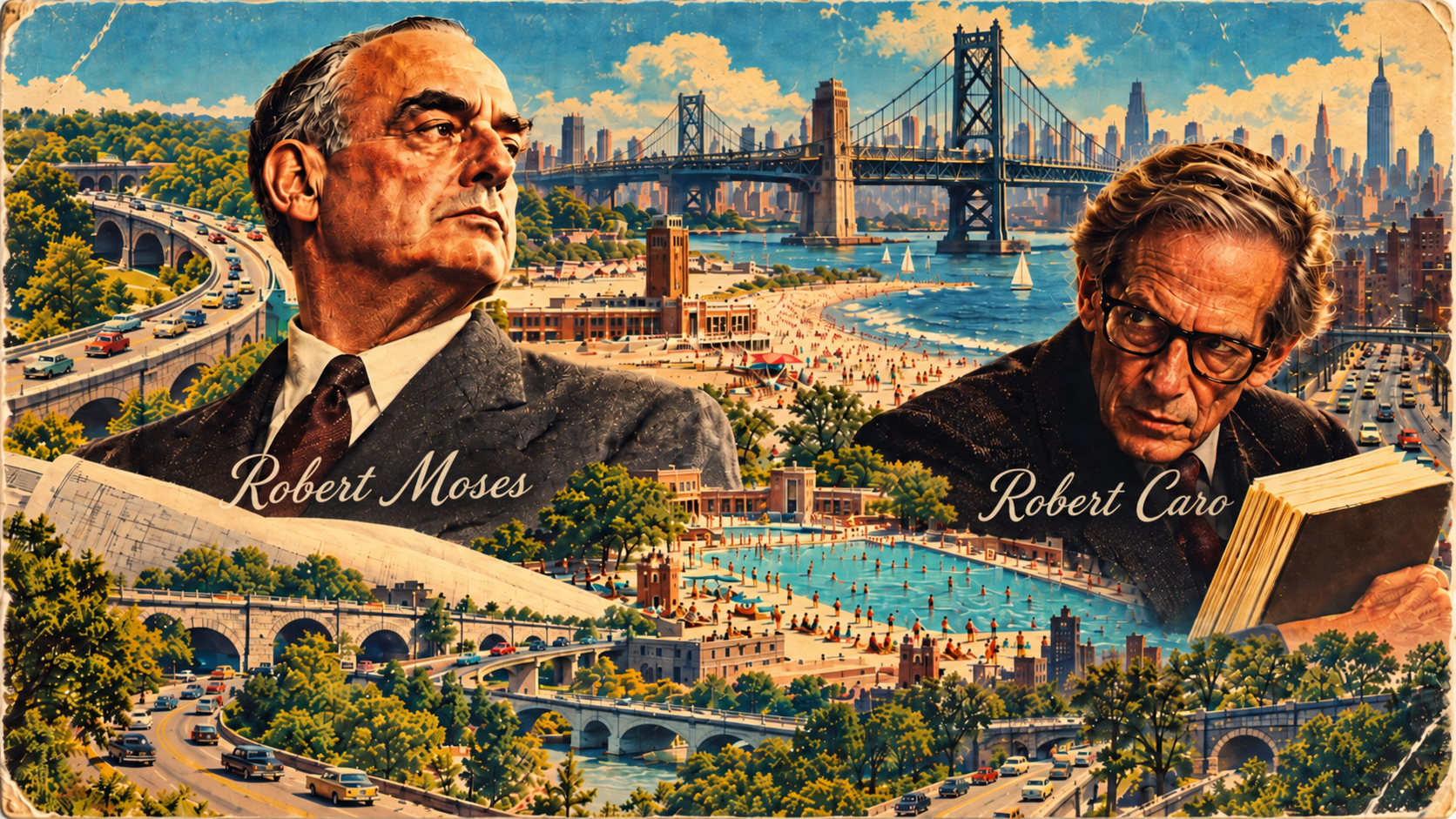
I didn’t set out to write about Robert Moses. I knew he had lived in a town near mine, and I had visited and sailed Jones Beach many times, driven the parkways, crossed the bridges, and for years admired the scale, ambition, and sheer audacity of what he built.
Then, on a recent flight, I watched Motherless Brooklyn. I knew Moses Randolph was supposed to be Robert Moses, but I was stunned by what the film attached to him: corruption, racial hatred, murder, blackmail, and rape. The accusations were so grotesque that I decided to find out how much of this monster actually existed.
That led me to Robert Caro’s The Power Broker. I bought the book, read it, followed the sources, and started pulling on the threads.
The deeper I dug, the uglier the picture became, but not for Moses. I found false claims, loaded exaggerations, selective evidence, manufactured motives, and outright fabrications that had hardened into accepted history through fifty years of repetition and the institutional blessing of a Pulitzer Prize.
Prosecuting a dead man is easy: he cannot answer. He cannot produce the document that was omitted, confront the witness, expose the distortion, challenge the invented motive, or sue the person who smeared him. Once a man is dead, whoever controls the story can begin replacing his life with whatever version survives in print. Defending the dead is therefore work left to the living.
So I went back to the evidence with three questions: Who was Robert Moses really? How and why did Robert Caro build his professional reputation around the destruction of Moses’s? And how much of the monster we inherited was constructed after Moses was no longer alive to defend himself?
Caro Found No Corruption
The first problem with Caro’s indictment is devastating because Caro supplied it himself. After years of digging through Moses’s finances, contracts, authorities, political relationships, and public works, he conceded that “in terms of money, the terms in which corruption is usually measured, Robert Moses wasn’t himself corrupt.” He called Moses “money honest” and acknowledged that, despite controlling enormous sums of public money for decades, Moses showed remarkably little interest in enriching himself.
That should have ended any attempt to cast Moses as another Boss Tweed. Caro found no secret fortune, no bridge tolls diverted into private accounts, no construction empire designed to feed Moses personally, and no conventional graft sufficient to explain his career. Moses accumulated enormous power, but he used that power principally to build.
Caro therefore changed the indictment. If Moses couldn’t be made corrupt through money, power itself would become the corruption. The authority required to condemn land, issue bonds, protect revenues, defeat obstruction, and complete enormous public works was recast as evidence of moral decay. Caro didn’t expose a thief. He redefined the crime until the builder fit it.
The Manufactured Revelation About Unelected Power
Caro’s explanation for why Robert Moses fascinated him has become part of his own mythology. He presents Moses as the man who supposedly opened his eyes to a great hidden truth about American government: political power didn’t necessarily come from elections. Here was a man who had never been elected mayor or governor, yet could overpower mayors, governors, legislators, borough presidents, agencies, and local communities. Caro presents this as the intellectual revelation that set him on the road to The Power Broker.
For a New York political reporter, the story is almost absurd.
New York had spent generations demonstrating exactly how unelected political power worked. Tammany Hall wasn’t an obscure historical footnote. It was one of the most famous political machines in American history. Its district leaders, contractors, judges, patronage brokers, financiers, ward captains, newspaper allies, and party bosses exercised enormous power without needing to occupy every elected office themselves. Boss Tweed didn’t have to be mayor to dominate City Hall. The machine’s power came precisely from its ability to control nominations, appointments, contracts, judgeships, patronage, campaign machinery, and elected officials from behind the formal structure visible to the voter.
That was the whole point of the machine. So Caro didn’t need Robert Moses to discover that power could operate outside elected office. New York politics had been teaching that lesson for a century. Anyone seriously covering politics in the city already knew that the person holding the title wasn’t necessarily the person holding the power.
What made Moses different wasn’t that his power was unelected. What made him useful to Caro was that he exercised extraordinary power without fitting the traditional corruption model that made Tammany so easy to condemn.
Boss Tweed converted political control into personal wealth. Public contracts became instruments of theft. Patronage fed the organization. Government became a mechanism for enriching the men controlling it.
Moses presented a far more difficult target. He accumulated enormous administrative authority, but Caro couldn’t show that he was principally using it to make himself rich. The power produced bridges, tunnels, parkways, beaches, parks, public pools, playgrounds, housing projects, and regional infrastructure. Caro himself conceded that Moses was personally “money honest.”
That distinction created the central problem The Power Broker had to solve. If Moses wasn’t Boss Tweed, then Caro had to make power itself the scandal. The public authority became sinister because it was independent. Dedicated toll revenue became sinister because politicians couldn’t easily raid it. Long-term administrative continuity became sinister because it survived elections. Political alliances became sinister because they allowed Moses to overcome opposition. His ability to defeat people trying to stop projects became evidence that no one man should possess such power in the first place.
The supposed revelation about “unelected power” therefore does more than provide Caro with an origin story. It establishes the moral vocabulary of the entire book. Once unelected power itself is treated as inherently suspicious, Moses begins the trial already halfway convicted.
That is the real difference between Tweed and Moses. Tweed showed what happens when political power is converted into private loot. Moses showed what happens when political power is converted into public construction. Caro spent twelve hundred pages trying to persuade readers that the second was somehow the more frightening story.
Power Was Part of the Construction Machinery
Robert Moses accumulated power because large public works require power. Eminent domain requires authority. Bond financing requires authority. Toll revenues must be protected from raids by politicians looking for money elsewhere. Land must be assembled. Railroads and utilities must be moved. Municipal, state, and federal agencies must be coordinated. Contractors must be paid. Projects that take years or decades must survive elections, changes of administration, budget fights, lawsuits, neighborhood opposition, and the endless temptation of politicians to reopen decisions already made.
Regional infrastructure cannot be redesigned every four years because a new mayor, governor, borough president, commissioner, neighborhood committee, or interest group objects to the route.
Administrative power was therefore not some accidental byproduct of Moses’s career. It was part of the construction machinery. Concrete, steel, financing, engineering, land, and political authority were all necessary to turn a line on a map into an operating bridge, tunnel, highway, beach, park, pool, or public facility.
Caro’s technique was to take that necessary instrument and convert it into the offense. An authority became an escape from democracy. Dedicated revenue became a private treasury. Political alliances became a machine. Institutional continuity became an empire. Resistance to interference became arrogance. Refusal to abandon a project became obsession. The ability to defeat opposition became evidence of tyranny.
The result is a beautifully constructed trap. Every mechanism Moses used to make government function becomes evidence that he had too much power, while every obstacle he overcame disappears from the indictment.
Caro himself supplied the contradiction. Recalling his first trip to meet Moses, he described driving over the Henry Hudson and Triborough bridges, projects generations of politicians had failed to build, traveling along expressways Moses had completed, and crossing parkways that powerful interests had once sworn would never be allowed.
That was the physical record. New York had spent decades proving that ordinary political machinery could debate these projects, study them, delay them, fight over them, and fail to build them.
The Narrative Trick: Make the Cost Human and the Benefit Invisible
Caro’s most powerful technique is not factual but narrative. He gives the cost of construction a human face and allows the benefit to dissolve into abstraction.
When a project displaces a family, Caro reconstructs the people who lived there, the apartment, the neighbors, the stores, the children, the routines, and the moment government announced that the block would disappear. The planning decision becomes a personal catastrophe. The reader knows who lost the home, what the home meant, and who is to blame for its destruction.
The benefit created by the same project is almost impossible to narrate with comparable emotional force. The condemned family can be interviewed. The ten-millionth person to cross the completed bridge cannot. The ambulance that reaches the hospital faster, the delivery truck that supplies Manhattan, the worker whose job becomes reachable, the family that gets to Jones Beach, the child using a public playground, the businesses connected by a regional road system, and the millions of ordinary trips made possible over the next half-century never assemble in one room for Caro to interview.
So the cost acquires names, faces, memories, grief, and dialogue. The benefit becomes traffic volume. That imbalance is devastatingly effective. Caro can spend pages describing the destruction of a block while the highway, bridge, park, or tunnel produced by that destruction eventually becomes background scenery. The reader experiences the demolition in intimate detail and then inherits the completed infrastructure almost unconsciously, as though it simply appeared. Caro itemizes the destruction and treats the asset created by it as scenery. The missing variable is the cost of not building.
A metropolis cannot preserve every existing block while simultaneously absorbing population growth, automobiles, trucks, regional commerce, emergency traffic, airports, suburban expansion, utilities, public recreation, and interstate movement. Bridges require approaches. Tunnels require portals. Highways require rights-of-way. Rail lines require corridors. Reservoirs flood land. Airports consume acreage. Parks require property. In a mature city, there is no magical empty route waiting for infrastructure to pass through without touching anyone.
Something moves. Something is demolished. Somebody loses. The real comparison was therefore never between Moses’s New York and an imaginary version of the same city containing all of his bridges, tunnels, beaches, parkways, pools, parks, playgrounds, and regional roads without the condemnations required to build them.
The real comparison was between the city Moses built and the city that would have existed if those projects had been delayed, rerouted, reduced, abandoned, or made impossible. Caro makes the cost of action visible. He rarely forces the reader to stare equally hard at the cost of inaction.
The Low Bridges: From Physical Fact to Psychological Verdict
The Jones Beach bridge story is perhaps the cleanest example of how Caro turns a physical fact into a psychological verdict.
The bridges were low. The parkways were designed primarily for passenger automobiles. Large commercial vehicles and buses were restricted. Those are facts. The transformation begins when Caro moves from those facts to motive. The bridges were supposedly made low specifically to keep buses off the parkways. Keeping buses off the parkways was supposedly intended to keep poor people away from Jones Beach. Because Black New Yorkers disproportionately relied on public transportation, the bridge heights were then converted into instruments of racial exclusion.
By the time the story reached popular culture, the entire chain had collapsed into a slogan: Robert Moses built racist bridges. But that is not the same proposition as saying Robert Moses built low bridges.
The distinction matters because buses did, in fact, reach Jones Beach. Passenger-car-only parkways were also a recognized road type, with restrictions extending beyond racial or class considerations. Later historians, including Kenneth Jackson, challenged Caro’s interpretation, while subsequent physical measurements confirmed that some Moses-era overpasses were unusually low. The disputed issue was never whether low bridges existed. Of course they existed. The issue was whether Caro had actually proved the motive he attached to them.
That is where the evidentiary transformation occurs. A bridge height is measurable. A traffic restriction is documentable. A bus route can be traced. But the claim that Moses selected a particular clearance because he intended to exclude Black New Yorkers requires evidence of intent. Caro bridges that gap narratively, and once the reader accepts the motive, every physical fact beneath it becomes retroactive confirmation. The low bridge proves the exclusion, the exclusion proves the racism, and the racism is then used to explain the low bridge.
The same method appears repeatedly throughout The Power Broker. A building was demolished, therefore Caro’s explanation for why it was demolished is accepted. A political ally benefited, therefore the project becomes a favor to that ally. An alternative route existed, therefore Moses’s rejection of it becomes evidence of malice rather than engineering, cost, land acquisition, traffic, or administrative judgment. The document establishes the event, Caro supplies the motive, and repetition eventually welds the two together until the inference is remembered as though it were part of the documentary record itself.
Carnegie Paid for the Investigation
Caro’s transformation from a newspaper reporter pursuing Robert Moses into the author of a multiyear book project was made possible by Carnegie Corporation of New York. In 1967, Carnegie awarded him a journalism fellowship that paid his salary and gave him an institutional base at Columbia University’s Graduate School of Journalism. Carnegie’s own retrospective account credits the fellowship with giving Caro the time and resources necessary to pursue the Moses investigation, and Caro himself later emphasized how important that support had been.
The irony is impossible to miss. Caro’s great subject became the danger of unelected institutional power, yet his investigation was financed by one of America’s great unelected philanthropic power centers. Carnegie possessed accumulated private wealth and used it deliberately to determine which problems deserved investigation, which scholars and journalists deserved support, which academic fields would expand, and which political and social questions would receive institutional attention. It exercised influence not through elections but through money, universities, research programs, legal initiatives, expert networks, and the prestige attached to the institutions it financed.
This wasn’t passive charity. Carnegie’s own institutional history describes a deliberate program of social intervention. Under Alan Pifer, who became president in 1967, the same year Caro received his fellowship, the Corporation moved beyond merely studying social problems and began financing organizations that “created agendas, organized for change and actively pursued legal strategies.” Carnegie money had already helped create the Institute of Economics, later absorbed into the Brookings Institution, and financed major programs in education, public policy, international affairs, and the manufacture of elite expertise.
Its Soviet work is especially revealing. Beginning in 1948, Carnegie supplied seed money for Harvard’s Russian Research Center and helped construct Soviet-studies programs throughout elite American universities. What began under the justification of understanding America’s Cold War adversary developed over time into something considerably more intimate. Carnegie-funded scholarship and institutional programs increasingly cultivated Soviet contacts, Soviet-American academic relationships, policy exchanges, and an intellectual environment in which engagement with Moscow became an institutional objective in its own right.
From 1983 onward, Carnegie says it invested roughly $120 million in programs intended to build institutional linkages, encourage cooperation, influence scholarly and policy attention, and “cement closer bonds” between the United States and the Soviet and post-Soviet worlds. This wasn’t politically neutral scholarship floating above the Cold War. Carnegie was using private wealth to construct relationships, select intermediaries, finance academic networks, and promote a policy environment increasingly sympathetic to accommodation and engagement with the Soviet system. What had begun as Soviet studies carried a pronounced pro-Soviet institutional bias.
The point is not that Carnegie studied the Soviet Union. It helped build the American institutions that decided who would interpret the Soviet Union for policymakers, universities, journalists, and the public. Money determined access. Access created expertise. Expertise created authority. Authority shaped policy. Carnegie sat at the beginning of that chain.
The same pattern appears in its South African work. Its investigation of the “poor white problem” selected a racial and social question, financed experts to define and study it, and produced a body of knowledge that entered the political environment in which white racial policy was later rationalized. Carnegie wasn’t just observing society. It was helping decide which problems would be studied, how they would be framed, who would receive the authority to interpret them, and which conclusions would enter elite political discourse.
Caro therefore didn’t stand outside the system of unelected power he claimed to expose. His project was born inside it. Carnegie selected the investigator, paid for his time, supplied the institutional shelter, and enabled the production of the work that would later condemn another man for accumulating institutional power outside the ballot box.
Columbia’s Soviet Subversion Penetration
The Columbia institution into which Carnegie placed Caro had its own long and uncomfortable history at the intersection of radical politics, Soviet intelligence, Marxist scholarship, and American elite culture. Columbia wasn’t simply a university in which political ideas happened to circulate. Its extraordinary position in American intellectual life made it a recruiting ground, meeting place, and institutional home for people operating across the boundary between ideology, government, scholarship, and espionage.
Whittaker Chambers passed through Columbia before entering the Communist underground and becoming a courier for a Soviet espionage network. His later defection exposed the machinery by which American intellectuals and government officials could be recruited into clandestine service for Moscow. Chambers wasn’t a marginal crank wandering through some obscure political sect. He came out of the same elite metropolitan intellectual world that treated Columbia as one of its principal institutions.
Isaiah Oggins followed an even darker trajectory. A Columbia graduate, he entered the Soviet underground and worked for Soviet intelligence in Europe and Asia. He was eventually arrested inside the Soviet Union and, when Moscow concluded that allowing him to return to the United States might expose its operations, he was murdered on Stalin’s orders. His life traced the complete arc from American university education to clandestine Soviet service and finally liquidation by the regime he had served.
Victor Perlo provides an even cleaner counterintelligence case. He earned both his bachelor’s and master’s degrees at Columbia, entered the United States government, and became part of the Soviet espionage apparatus operating inside it. The National Security Agency’s declassified VENONA material identifies Perlo as a KGB agent and records the transmission of secret American government and military information, including material about the P-80 jet aircraft. Here the progression wasn’t ideological sympathy followed by innocent academic exchange. It was Columbia > government access > espionage.
Juliet Stuart Poyntz likewise moved through the Columbia-Barnard world into revolutionary politics and clandestine Soviet activity. She studied at Barnard and Columbia, worked and taught in Columbia’s intellectual orbit, became a prominent figure in the American Communist movement, and eventually entered Soviet underground work. After becoming disillusioned with Stalinism, she disappeared in New York in 1937 and was widely believed to have been eliminated by Soviet intelligence. Her case illustrates the extent to which the radical intellectual culture surrounding elite American universities could provide both ideological formation and recruits for foreign revolutionary organizations.
Columbia also became the American home of the Institute for Social Research, known as the Frankfurt School, after its flight from Germany. The Institute brought an explicitly Marxist intellectual tradition into Morningside Heights and provided an institutional base for scholars attempting to reinterpret Western society through Marxist categories of class, culture, authority, and ideology. Paul Massing, who worked with the Institute, had himself passed through the German Communist movement before eventually breaking with Stalinism. The significance was larger than any single individual: Columbia became one of the places where European Marxist political theory was transplanted into American academic life and given enormous intellectual reach.
These were not isolated curiosities scattered randomly across a century. Columbia’s prestige, access, social networks, international programs, and proximity to government and media made it unusually valuable terrain for ideological and intelligence operations. People educated there moved into journalism, diplomacy, government, foundations, universities, and the national-security apparatus. Influence introduced at Columbia didn’t remain confined to a classroom. It traveled outward through institutions that shaped American policy and public understanding.
That is the institutional setting in which Caro received his Carnegie-funded office. His investigation of Robert Moses emerged from that world, not from some politically sterile newsroom detached from the ideological struggles of the twentieth century.
Case Study: Sula Benet and the Soviet Academic Channel
Sula Benet (who was likely a Russian operative) offers a useful case study of how easily the boundary between American scholarship and Soviet institutions could become porous. Benet, a Polish refugee who immigrated to the US in 1936, received her doctorate from Columbia, specialized in Eastern European and Slavic culture, and built an academic career around precisely the part of the world in which Soviet institutions exercised enormous control over access, archives, fieldwork, and scholarly exchange.
In 1970, Benet began extensive field research in the Soviet Union at the invitation of the USSR Academy of Sciences. That relationship didn’t end with a single academic visit. Her work developed into a joint American-Soviet multidisciplinary longevity project involving researchers on both sides, and shortly before her death she was editing an English-language edition of the Soviet ethnographic work The Peoples of the Soviet Union. Her archival record shows sustained professional engagement with Soviet academic institutions.
That matters because Soviet academic exchange was never merely academic in the Western sense. Access to Soviet institutions, field sites, scholars, publications, and research programs existed inside a state system in which scholarship, propaganda, intelligence, and foreign influence routinely overlapped. An American scholar working through Soviet institutions was therefore operating inside channels the Soviet state itself controlled.
My own examination of Benet’s famous claim that the biblical qaneh-bosem referred to cannabis led me back into that institutional history. The issue wasn’t simply whether her linguistic argument was right or wrong. The more interesting question was how claims produced within heavily mediated Soviet-American academic networks acquired authority in the United States and then circulated for decades as scholarship detached from the political and institutional environment that had helped produce them.
Benet’s case is relevant not because it proves that every Soviet-linked academic was an intelligence asset, but because it exposes the channel itself: Columbia-trained scholarship, Soviet institutional access, joint research programs, foundation and university sponsorship, and the subsequent transmission of those claims into American academic and popular culture. In Benet’s case, that included arguments portraying marijuana as historically legitimate, comparatively harmless, and even recommended for use. The channel existed, it was durable, and it operated inside the same larger ecosystem of universities, foundations, journalism, government, and foreign institutions that surrounded Caro’s own work.
Columbia Journalism and the Government Information Establishment
Columbia’s Graduate School of Journalism wasn’t simply a neutral trade school teaching reporters how to write leads. It had its own history at the intersection of journalism, government information operations, foreign policy, and elite institutional power.
Under Dean Carl Ackerman, Columbia participated during the Second World War in a journalism program in Nationalist China that was secretly financed by the Office of Strategic Services, the predecessor of the CIA. Columbia’s own institutional history acknowledges the OSS funding and the political purposes surrounding the project. Journalism education, foreign-policy objectives, and covert government support were therefore already intertwined at the school decades before Caro arrived.
The pattern continued under Edward W. Barrett, who served as dean during the period encompassing Caro’s fellowship. Barrett didn’t come to Columbia from an apolitical newsroom. During the Second World War, he had headed overseas operations for the Office of War Information. Under President Truman, he became Assistant Secretary of State for Public Affairs, placing him directly inside the machinery of American international information strategy during the early Cold War. He participated in the government’s effort to counter Soviet propaganda and shape foreign public opinion before moving into one of the most influential journalism schools in the country.
This institutional history matters because it destroys the fiction that Caro’s work emerged from some pristine world in which an independent reporter simply confronted raw political power. Columbia Journalism itself sat at the junction of journalism, intelligence, government messaging, philanthropy, foreign policy, and influence operations. The same school that provided Caro with an institutional base had already participated in government-backed information operations abroad and was led by men whose careers moved directly between journalism, propaganda, diplomacy, and public affairs.
Caro was therefore investigating one form of unelected power from inside another. Robert Moses exercised power through authorities, bonds, toll revenues, engineering, and construction. Columbia and its surrounding institutional network exercised power through information: deciding who would be trained, who would be funded, what would be investigated, which narratives would acquire prestige, and which interpretations would ultimately enter the historical canon.
Jane Jacobs: Foundation-Funded Opposition Becomes Canon
Jane Jacobs underwent a remarkably similar transformation from critic to institution. The popular image is irresistible: an ordinary neighborhood woman armed with common sense confronts Robert Moses, the all-powerful master builder, and defeats him on behalf of the people. That image became one of the central moral legends of postwar urban history.
The reality contained considerably more machinery. After Jacobs’s early criticism of postwar planning attracted attention, the Rockefeller Foundation financed the research and writing that became The Death and Life of Great American Cities. The Rockefeller official who cultivated and funded Jacobs was Chadbourne Gilpatric, a former OSS officer and CIA operations official who had moved from intelligence work into philanthropy. The Rockefeller Archive Center describes the grant as part of a broader urban-design program intended to shape the developing field, and Jacobs herself acknowledged that Rockefeller support made the research and writing possible. One of the most influential attacks on Moses-era planning was therefore not the product of an isolated housewife standing alone against institutional power. It was nurtured and financed by one of the wealthiest philanthropic institutions in the United States, under the sponsorship of a man whose earlier career had been spent in intelligence operations.
That support mattered because Death and Life did far more than criticize individual projects. It supplied Marxist intellectual vocabulary for attacking the entire planning philosophy associated with Moses: large-scale redevelopment, superblocks, arterial roads, clearance programs, top-down design, and the assumption that professional planners could impose order on the city from above. Jacobs transformed resistance to individual projects into a coherent critique of centralized urban planning.
She also became far more than a writer. Jacobs learned how to defeat projects procedurally and politically. She organized opposition to urban-renewal designations, mobilized neighborhood groups, cultivated press attention, chaired the Joint Committee to Stop the Lower Manhattan Expressway, and helped turn public hearings and administrative choke points into weapons against major construction projects. During a 1968 hearing on the expressway, protesters, in a BLM/Antifa style, charged the stage, stenographic records were destroyed, and Jacobs was arrested.
Her political activity also extended beyond zoning and sidewalks. Jacobs opposed the Vietnam War and later moved her family to Canada while her sons were approaching draft age. The broader urban movement that elevated her overlapped with preservation campaigns, civil-rights activism, antiwar organizing, neighborhood mobilization, academic criticism, and opposition to centralized planning.
The anti-Moses coalition around Washington Square reflected the same environment. Shirley Hayes, one of its leading organizers, later became a charter member of the National Organization for Women and worked with the Lindsay administration. The coalition attracted prominent figures including Margaret Mead, Lewis Mumford, and Charles Abrams. Mumford had long argued for more decentralized, human-scale urban development, while Abrams became one of the major advocates of public housing and government intervention in the housing market.
This was therefore never simply a spontaneous collection of mothers defending a park from a bulldozer. It was an increasingly sophisticated coalition of progressive and socialist neighborhood organizers, preservationists, writers, academics, reformers, media allies, and foundation-supported critics confronting the centralized construction state represented by Robert Moses.
Their greatest victory wasn’t just stopping a highway. They changed the moral language of urban government. Large-scale construction increasingly became something that had to justify itself before organized opposition, while resistance acquired the language of democracy, community, preservation, participation, and local control. Moses had once forced projects through resistance. Jacobs and the movement that followed her helped institutionalize the resistance itself.
From Villain to Criminal: Motherless Brooklyn
By the time Edward Norton made Motherless Brooklyn in 2019, portraying Robert Moses as arrogant, ruthless, or authoritarian was no longer enough. The cultural prosecution had advanced another stage. The builder now had to become a criminal.
Norton took Jonathan Lethem’s novel, moved the story backward into the 1950s, and created Moses Randolph, an unmistakable Robert Moses surrogate played by Alec Baldwin. The historical disputes over highways, urban renewal, slum clearance, land acquisition, public authorities, and metropolitan planning were converted into noir. Randolph is surrounded by blackmail, corruption, intimidation, hired muscle, murder, and racial contempt. Most grotesquely, Norton invented a sexual crime and attached it directly to the Moses figure: Randolph admits raping a Black hotel employee in a supply room and fathering her daughter.
The scene does more than make Randolph personally vicious. It deliberately fuses sexual violence with the exercise of public power. The same character who drives highways through neighborhoods and bulldozes communities is made into a rapist. Political domination, urban redevelopment, racial contempt, sexual violence, and criminality are collapsed into a single moral personality. Once that fusion is complete, the planning argument is over. The audience is no longer being asked whether Moses’s projects were justified, necessary, destructive, or beneficial. It is being taught to associate the entire Moses model of government with depravity.
Norton knew the rape was fiction. Discussing the film, he expressly acknowledged that the story contains “assaults and rapes and illegitimate children” that “don’t have anything to do with Robert Moses.” That admission strips away any pretense that the ugliness was inherited from the historical record. The filmmakers knowingly manufactured crimes that Robert Moses had never been accused of committing and attached them to a character whose name, offices, methods, public works, political battles, and physical transformation of New York were deliberately modeled on him.
That is character assassination by fictional substitution. By then the anti-Moses narrative had become self-propelling. Caro had already established the template of the authoritarian master builder who destroys neighborhoods, abuses power, and treats ordinary people as obstacles. Popular culture no longer needed to prove those propositions. It could inherit them as settled fact and then add whatever crimes were required to complete the monster.
The progression is revealing. The argument begins with whether Robert Moses exercised too much administrative power. It ends with his fictional surrogate raping a powerless black woman in a hotel supply room. Somewhere along the way, historical criticism stopped being history and became reputational murder.
The Pulitzer System and the Canonization of Narrative
The final institutional seal arrived in 1975 when The Power Broker received the Pulitzer Prize for Biography. The award did more than decorate Caro’s book. It helped transform a fiercely prosecutorial interpretation of Robert Moses into the authoritative account against which later accounts would be measured. A Pulitzer does not merely reward a narrative. It can canonize one.
The Pulitzer system itself possesses enormous cultural power. Administered at Columbia, its board determines which works will receive one of the most prestigious certificates available in American journalism and letters. Its decisions influence reputations, careers, publishers, universities, reading lists, and eventually the historical canon. That makes what happened with the 2018 National Reporting prize particularly instructive. The Board jointly rewarded The New York Times and The Washington Post for their reporting on alleged connections between the Trump campaign, transition, administration, and Russia while the underlying investigations were still unfolding.
The evidentiary pipeline behind the broader Trump-Russia narrative was subsequently exposed as extraordinarily contaminated. Perkins Coie, acting for the Clinton campaign, retained Fusion GPS to conduct opposition research on Trump. Fusion then hired Christopher Steele. Steele produced a series of reports containing damaging allegations and distributed those reports not merely to the FBI and government officials but to members of Congress and multiple news organizations. Durham later described the material as uncorroborated reporting financed by an opposing political campaign and concluded that government investigators failed to appreciate sufficiently that the reporting was intended to influence as well as inform them.
The source chain underneath some of the dossier’s most sensational allegations then collapsed. Durham concluded that Igor Danchenko never spoke with Sergei Millian and “simply fabricated” allegations attributed to him, including material used to support the claim of a developed conspiracy between the Trump campaign and Russian officials. Durham also reported that Charles Dolan acknowledged fabricating a separate Manafort-related allegation that reached Danchenko and entered the Steele reporting stream. These were not minor discrepancies around the edges of an otherwise pristine intelligence product. Fabricated material had entered the bloodstream of the dossier itself.
The press wasn’t merely observing this process from a safe distance. Steele briefed Yahoo News reporter Michael Isikoff in September 2016. Isikoff then published a story reporting allegations concerning Carter Page and Russian officials. The Justice Department Inspector General later established that Steele was the “Western intelligence source” behind significant portions of that story. Yet the Yahoo article subsequently appeared in the Carter Page FISA process as supporting information even though Steele himself was the underlying source of the relevant allegations. Information had traveled from opposition research to a reporter, appeared in published journalism, and then returned to government investigators wearing the appearance of independent corroboration.
That circularity is critical. A political research operation could seed an allegation with a journalist; publication could convert the allegation into a news story; government investigators could then encounter the news story as apparently separate information; and subsequent reporting could cite the existence of the government investigation as additional reason to take the original allegation seriously. The same claim could acquire multiple institutional costumes without acquiring a second independent source.
The Inspector General later found that much of the Steele reporting used in the Carter Page applications couldn’t be corroborated, that some allegations were inaccurate or inconsistent with information gathered by investigators, and that what little could be corroborated often concerned publicly available details such as dates, locations, and titles. The government nevertheless expended enormous effort trying to validate the reporting.
The documentary corruption went further. FBI attorney Kevin Clinesmith altered an email concerning Carter Page’s previous relationship with another government agency by inserting language that changed its meaning before the altered document was used in the surveillance process. He later pleaded guilty to making a false statement. The Inspector General ultimately identified seventeen significant inaccuracies and omissions across the Carter Page FISA applications. At that point the record contained campaign-financed opposition research, fabricated source allegations, circular media sourcing, uncorroborated reporting, serious omissions, and an altered government document.
This is precisely why the Pulitzer’s role matters. The news organizations and reporters participating in the production and amplification of the Trump-Russia narrative were not detached auditors standing outside the information system. They were the people being rewarded by it. The 2018 Pulitzer went to the staffs of The New York Times and The Washington Post, and journalists including Maggie Haberman, Matt Apuzzo, Jo Becker, Mark Mazzetti, Rosalind Helderman, Tom Hamburger, Ellen Nakashima, Adam Entous, and Greg Miller stood on the Pulitzer stage accepting the prize. Haberman, Apuzzo, Becker, and Adam Goldman were among the bylined reporters on stories included in the winning submission.
The press didn’t have to originate every fabricated allegation for it to become public reality. Publication performed the crucial laundering function. Once an allegation appeared under the masthead of The New York Times or The Washington Post, it ceased to look like raw political opposition research and became “reported” information. The same journalistic establishment that helped fabricate these allegations was then awarded the Pulitzer for the resulting coverage.
The Mueller investigation ultimately stated that it “did not establish that members of the Trump Campaign conspired or coordinated with the Russian government” in the conduct under investigation. Yet by then years of headlines, investigations, anonymous-source stories, dossier reporting, congressional theater, and institutional awards had already constructed a public narrative vastly larger than the evidentiary foundation beneath it.
The Pulitzer Board nevertheless refused to rescind the 2018 prize. After criticism of the award, it commissioned two reviews and announced that neither had identified a winning passage, headline, contention, or assertion discredited by later facts. The same institution that had conferred the authority then conducted a review of the work it had honored and announced that the authority would stand.
That is what makes the episode relevant to Robert Caro. The Pulitzer is not merely an ornament attached after history has reached a final judgment. It is capable of intervening while the evidence is still contested and conferring enormous cultural authority on one narrative. Once that happens, the prize itself becomes part of the narrative’s defense. The work is authoritative because it won the Pulitzer, and the Pulitzer is vindicated because authoritative work supposedly won it.
In 1975 that mechanism helped transform Caro’s prosecution of Robert Moses into canonical history. The accusations no longer had to win the argument from the beginning every time. They had the Pulitzer seal stamped across the cover.
The Anti-Moses Narrative Became Self-Reproducing
Once The Power Broker had been canonized, the anti-Moses narrative no longer had to be rebuilt from the evidence. Later writers inherited Caro’s conclusions as premises. Moses was authoritarian. Moses destroyed neighborhoods. Moses favored automobiles over people. Moses excluded minorities. Moses represented arrogant top-down planning. Jane Jacobs represented community, democracy, and resistance. The categories arrived preassembled.
That is how a contested interpretation becomes historical common sense. Each succeeding writer can begin where the previous one ended. Caro cites witnesses and constructs motives; later authors cite Caro. Journalists cite those authors. Documentary filmmakers cite the journalists. Professors assign the resulting literature. Popular culture absorbs the simplified version, and eventually a fictional Moses can be made into a rapist without the audience needing any explanation of why it should already despise him.
At that stage, repetition begins masquerading as corroboration. Ten books repeating the same accusation do not constitute ten independent sources when nine of them ultimately descend from the first. Yet the accumulated citations create the appearance of overwhelming agreement. What began as Caro’s interpretation becomes “what everyone knows” about Robert Moses, while the original evidentiary chain disappears beneath layers of secondary repetition.
The Post-Moses City Exposed the Other Side of the Equation
The political culture that followed Moses didn’t just restrain concentrated power. It built an elaborate system designed to prevent any future builder from exercising comparable authority. Environmental review, preservation mandates, community consultation, litigation, overlapping permitting agencies, judicial intervention, local veto points, and procedural review accumulated layer upon layer. Each mechanism could be defended individually as a safeguard. Collectively, they produced a government extraordinarily capable of delaying, redesigning, litigating, and stopping major infrastructure.
California high-speed rail is the monument to that system. California voters approved the project in 2008, when the Authority projected roughly $33 billion in 2008 dollars for the Los Angeles/Anaheim–San Francisco backbone. Eighteen years later, in 2026, no passenger had ridden a California high-speed train. Only 119 miles in the Central Valley were in active construction. The Authority anticipated initial fare service between Merced and Bakersfield in 2033, while its optimized estimate for the full San Francisco–Los Angeles/Anaheim Phase 1 system had risen to roughly $126 billion. Under its newer bottom-up methodology, rebuilding the previously contemplated full Phase 1 scope approached $231 billion.
The irony became almost comic when the High-Speed Rail Authority’s own 2026 plan began asking Sacramento for relief from the very procedural machinery that had accumulated around modern public works. The Authority sought a CEQA exemption for certain electrical infrastructure, streamlined environmental permitting, priority court access, binding deadlines on third-party reviews, and greater permitting authority because the existing process was obstructing delivery.
In other words, after decades spent building safeguards against another Robert Moses, the system began asking for powers identical to the ones Moses used to get things built.
That is the half of the equation Caro’s morality play leaves out. Concentrated power can impose immediate and visible costs, but fragmented power imposes costs of its own: delay, duplication, litigation, escalation, political paralysis, and eventually the inability to complete the project at all. Moses’s methods were brutal because construction itself is brutal. Land has to be taken, routes chosen, objections overruled, money committed, and decisions made permanent enough for steel and concrete to follow.
California demonstrates the opposite failure mode. A state can possess money, engineers, voters, legislation, environmental commitments, and political consensus that a project ought to exist, yet remain trapped for decades in the machinery required to obtain permission to build it.
Caro’s Ultimate Achievement
Caro’s great achievement in the Robert Moses story wasn’t discovering corruption. After years of investigation, he conceded that the ordinary corruption case wasn’t there. Moses had controlled staggering amounts of money without turning public power into personal wealth. Caro therefore changed the charge. If Moses couldn’t be convicted as a thief, the accumulation of the power necessary to build would itself become the crime.
From that moment, effectiveness became evidence against the defendant. Moses created authorities because ordinary government couldn’t deliver projects; Caro called that evasion of democracy. Moses protected revenues so construction money couldn’t be raided; Caro made that an independent empire. Moses assembled political coalitions; Caro called them machines. Moses defeated opponents; that became ruthlessness. He refused to abandon projects; that became arrogance. He finished what others couldn’t; that became domination. Caro built a system of accusation in which Moses couldn’t succeed without supplying another exhibit for the prosecution.
That was the brilliance of the attack. Moses’s greatest strength was turned into the proof of his guilt.
The Power Broker was consequently more than a hostile biography. It was a lavishly subsidized act of reputational demolition aimed at an entire philosophy of government: centralized authority, technical competence, institutional continuity, aggressive construction, intolerance for endless vetoes, and acceptance of concentrated short-term costs when the result was infrastructure serving millions of people for generations. Carnegie supplied Caro the time. Columbia supplied the institutional home. Knopf and The New Yorker supplied the megaphone. The Pulitzer supplied the seal of legitimacy. Caro supplied the weasel language.
Caro’s magnum opus requires continual maintenance. Universities teach it. Journalists recycle it. Documentaries repeat it. Preservation organizations quote it. Screenwriters enlarge it. Hollywood eventually supplied the final degradation, turning the Moses surrogate into a rapist and criminal when the historical record would not provide the required crimes. Each generation applies another coat of moral sewage to a reputation already buried beneath the last one.
And now the payload is visible. The attack on Robert Moses did more than destroy one man’s reputation. It helped criminalize the very qualities that had allowed American government to build at scale: concentrated authority, speed, institutional continuity, eminent domain, resistance to local vetoes, and the willingness to impose immediate disruption for benefits measured across generations. The builder became the villain; sabotage and obstruction became civic virtue.
That outcome deserves to be examined against the logic of Soviet active measures. American intelligence described those operations as attempts to undermine confidence in institutions, exploit domestic divisions, manipulate political movements, discredit opponents, and weaken a government’s ability to act effectively. The objective wasn’t necessarily to make Americans love the Soviet Union. It was enough to make the United States distrust itself, fight itself, and progressively lose the institutional capacity to act.
Seen through that lens, the anti-Moses campaign had an extraordinary strategic payoff. The man who could bulldoze through bureaucratic resistance and produce bridges, tunnels, parks, beaches, highways, and public facilities was transformed into the cautionary monster of American government. Every mechanism that had made rapid construction possible became morally radioactive. Anyone attempting to reproduce Moses’s capacity would thereafter encounter a political culture trained to regard decisive government itself with suspicion.
California high-speed rail is what victory looks like. Nearly two decades after voter approval, the country that once threw bridges across rivers and tunnels beneath them can spend billions navigating lawsuits, environmental reviews, permitting disputes, endangered-species consultations, local objections, redesigns, and overlapping jurisdictions while waiting for the train to arrive. We didn’t merely prevent another Robert Moses. We created a governmental immune system designed to attack one.
That is why paralysis should not be treated merely as an unfortunate side effect of the anti-Moses revolution. It is the strategic result that demands investigation. If the objective of an influence operation were to persuade Americans that the officials most capable of overcoming institutional resistance were inherently dangerous, while multiplying enough procedural restraints to make decisive government almost impossible, it would be difficult to design a more successful outcome.
Caro supplied the villain. The activist network supplied the moral vocabulary. Foundations and universities supplied money and legitimacy. The prestige press supplied amplification. The Pulitzer supplied canonization. Fifty years later, America can convene a stakeholder meeting about almost anything and build almost nothing.
If that was the payload, it detonated beautifully.
References
RISM, the Hub of Russian Subversion
After retiring from her teaching position at Hunter College, Sula Benet joined RISM (Research Institute for the Study of Man). This private research institute published on a variety of social science topics, including influential studies, some of which were federally funded, promoting the recreational use of Cannabis/marijuana and sexual promiscuity. In one such study promoted by the New York Times, the RISM researcher Vera Rubin concluded after a comprehensive survey of chronic marijuana use that marijuana had no adverse effects on the users.
Linkage analysis of the RISM researchers who promoted cannabis shows that they came from Columbia University, had both family and professional ties to Russia, and published and promoted pseudo-scientific materials that included known Russian Active Measures (like legalizing drugs in the West, telepathy, and telekinesis). Of note is that starting in 1930, the Soviets were fully aware of the adverse effects of marijuana and outlawed its cultivation, sale, and consumption of marijuana and were actively prosecuting offenders.
The bios of two of Sula’s RISM (likely Russian agents) collaborators:
Vera Dourmashkin Rubin
Born in Moscow in 1911 died in 1985. Rubin immigrated to the United States in 1912. The daughter of Elias Rubin, editor of a Russian-language newspaper, and the wife of Samuel Rubin (Affiliated with the Transnational Institute, an Amsterdam think tank that promotes world peace and the legalization of drugs). Rubin studied at New York University, graduating in 1930. She collaborated with Margaret Mead, and in 1952, she was awarded her PhD from Columbia University.
Ruth Landes
Born in Manhattan in 1908 died in 1991. Landes was a cultural anthropologist and a pioneer in studying “race and gender relations.” Her father, Joseph Schlossberg, was a member of the radical left wing of the American socialist movement and the editor of Dos Abend Blatt, the first socialist Yiddish daily in New York. Landes promoted progressive ideologies such as ‘flexible marriage’ and sexual promiscuity. She received her B.A. in Sociology from New York University in 1928, a master’s degree in 1929 from The New York School of Social Work, and a 1935 PhD in anthropology from Columbia University.