
There is a small verse in Surah Yusuf that does more damage than it first appears. It is not one of the famous theological texts. It is not about jihad or Muhammad’s marriages. It is quieter than that. Almost casual.
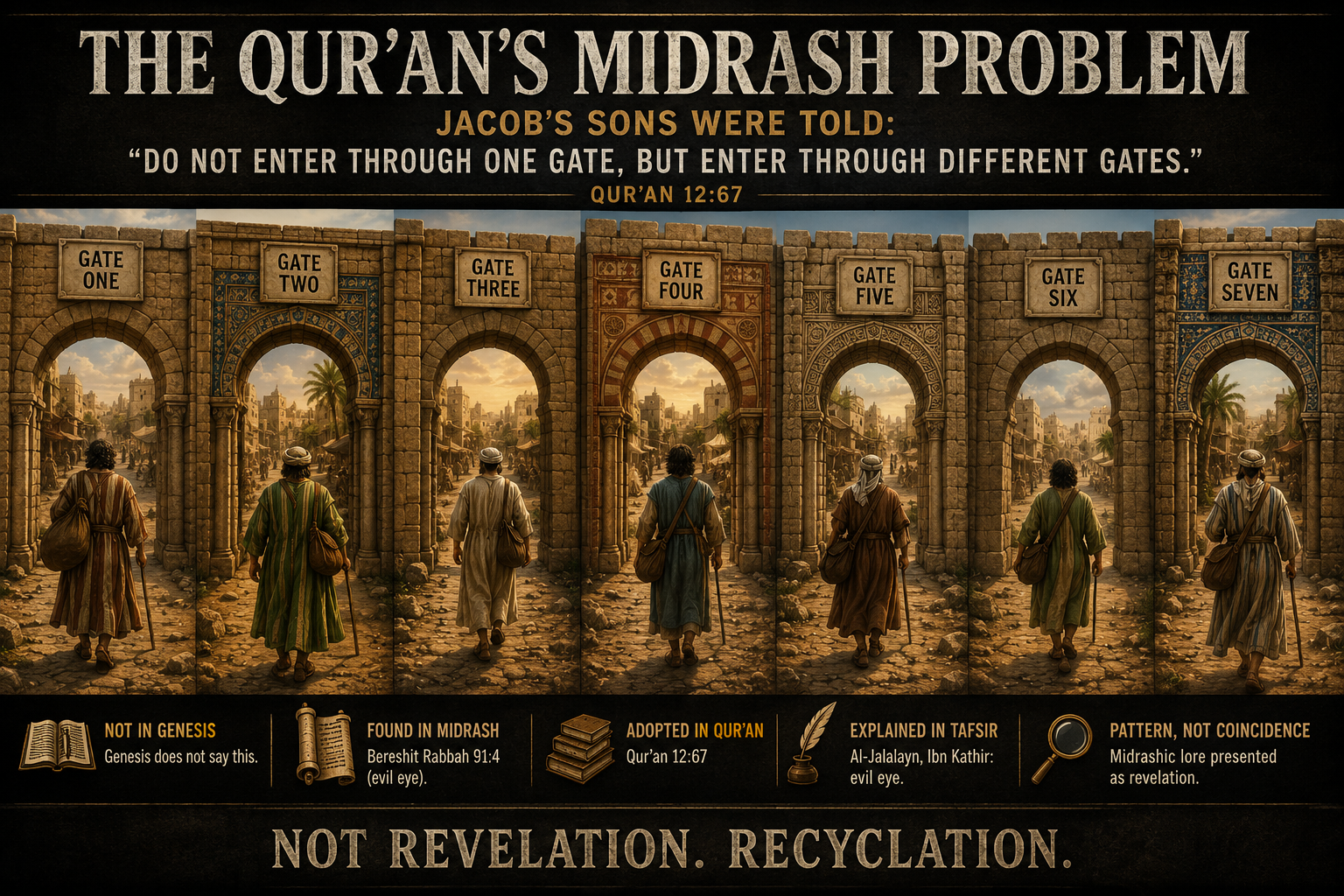
Jacob tells his sons not to enter Egypt through one gate, but through separate gates. That is Qur’an 12:67. The text says:
وَقَالَ يَـٰبَنِىَّ لَا تَدْخُلُوا۟ مِنۢ بَابٍۢ وَٰحِدٍۢ وَٱدْخُلُوا۟ مِنْ أَبْوَٰبٍۢ مُّتَفَرِّقَةٍۢ ۖ وَمَآ أُغْنِى عَنكُم مِّنَ ٱللَّهِ مِن شَىْءٍ ۖ إِنِ ٱلْحُكْمُ إِلَّا لِلَّهِ ۖ عَلَيْهِ تَوَكَّلْتُ ۖ وَعَلَيْهِ فَلْيَتَوَكَّلِ ٱلْمُتَوَكِّلُونَ ٦٧
“Do not enter through one gate, but enter through separate gates.”
At first glance, fine. A father gives his sons practical operational advice. But then the historian’s alarm bell goes off.
That detail is not in Genesis. The Torah does not have Jacob telling the brothers to enter Egypt through separate gates. But the detail does appear in Jewish midrashic tradition, specifically in aggadic midrash, meaning rabbinic narrative expansions and interpretive legends attached to biblical stories. This is the larger pattern: the Qur’an repeatedly absorbs aggadic midrash and presents it as revelation. Bereshit Rabbah 91:6 explains that Jacob feared the evil eye would harm his sons if they entered together.
“Jacob said to his sons: Why do you make yourselves conspicuous?” – he said to them: ‘Do not take out bread [perusa] perutot] in your hands, and do not enter all of you in one entrance, due to the evil eye.’
And then the Islamic tradition gives the game away. Tafsir al-Jalalayn explains Qur’an 12:67 the same way: Jacob told them to enter separately:
“And he said, ‘O my sons, do not enter Egypt by one gate, but enter by separate gates, lest the evil eye smite you. Yet I cannot avail, protect, you, by this that I have said, against God (min Allāhi: min is extra) anything, which He might have decreed against you; this [that I have said] is only out of affection [for you]. Judgment belongs to God alone. On Him I rely, in Him I trust, and on Him let all the trusting rely.”
“lest the evil eye smite you.” Ibn Kathir gives the same explanation, saying Jacob feared the evil eye because his sons were handsome and noticeable.
Muslim apologists usually have a ready answer for this common problem: tahrif. Whenever the Qur’an quotes or alludes to something supposedly from the Hebrew Bible that is not actually there, they claim the Jews have corrupted, altered, or removed it from their scripture. It is a convenient escape hatch, but it fails here. There is no theological reason, narrative motive, or polemical advantage for Jews to delete a harmless detail about Jacob’s sons entering Egypt through separate gates. The simpler explanation is also the more devastating one: the detail was never in Genesis. It came from Jewish commentary on Genesis.
That is the problem in miniature. The Qur’an is not restoring a lost version of Genesis. It is absorbing Jewish commentary on Genesis and then presenting it as divine revelation. This is not “Torah preserved in heaven.” This is a late antique folklore with a divine letterhead.
Why This Is a Serious Problem for Islam
The standard Islamic claim is not merely that the Qur’an is religiously inspiring. The claim is much larger: the Qur’an is the clear, uncreated, divinely revealed speech of God, delivered through Muhammad, correcting the corruptions of earlier Jews and Christians.
In plain English: the Qur’an keeps walking into the wrong library and checking out the footnotes.
This matters because Islam depends on three linked claims:
- That the Qur’an is an authentic divine revelation.
- The Qur’an reliably corrects earlier Jewish and Christian texts.
- That tafsir and hadith, whether Sunni or Shia, preserve reliable interpretive memory around that revelation.
The Midrash problem destabilizes all three. The Qur’an imports extra-biblical material. Tafsir often exposes the imported material by explaining it with the same Jewish or Christian legendary logic and vocabulary. Hadith then adds another layer of folklore, sometimes defending the mistake, sometimes expanding it, sometimes turning an exegetical pothole into a theological sinkhole.
The Wide Spread Pattern
The Jacob-and-the-gates example is not an isolated oddity. It is the first loose thread. Once pulled, the whole garment starts coming apart. The issue is not that the Qur’an knows Jewish and Christian stories. The issue is that it often knows them in their later, expanded, legendary, and sometimes confused forms. The following examples show the pattern:
1. Jacob’s Sons and the Evil Eye — Qur’an 12:67 says Jacob told his sons to enter Egypt through different gates. Genesis does not contain this instruction. Jewish Midrash explains the detail through fear of the evil eye. Muslim tafsir repeats the same explanation.
That means the Qur’an has not preserved a lost Torah detail. It has canonized rabbinic lore.
2. “Whoever Saves One Life” and Mishnah Sanhedrin — Qur’an 5:32 says God ordained for the Children of Israel that whoever kills one soul is as if he killed all humanity, and whoever saves one soul is as if he saved all humanity.
That is not a verse from the Torah. It closely tracks Mishnah Sanhedrin 4:5, where the rabbis teach that destroying one life is like destroying an entire world, and saving one life is like saving an entire world.
So the Qur’an says, in effect, “We decreed this for Israel,” but the source is not Mosaic legislation. It is a rabbinic moral commentary. The Qur’an has promoted Mishnah into Sinai.
3. Abraham Smashing the Idols — Qur’an 21:58 says Abraham smashed the idols, leaving the biggest one intact.
That story is not in Genesis. It is famous from Jewish Midrash, especially the Abraham-in-Terah’s-idol-shop tradition in Bereshit Rabbah 38:13.
Again, the Qur’an is not giving the biblical Abraham. It is giving the midrashic Abraham. The rabbis wrote a theological satire about idolatry, and the Qur’an treated the satire like archival footage.
4. Mount Sinai Lifted Over Israel — Qur’an 7:171 says God raised the mountain over the Israelites as if it were a canopy.
That is not the plain Exodus account. It matches the rabbinic image in Shabbat 88a, where God holds the mountain over Israel like an inverted barrel to compel acceptance of the Torah.
Once again, Qur’an is not simply “confirming” Torah. It is recycling rabbinic expansion.
5. Cain, Abel, and the Raven — Qur’an 5:31 says God sent a raven to show Cain how to bury his brother.
Genesis does not say that. The Qur’an uses an expanded legendary version of the Cain and Abel story. The written biblical narrative has become padded with later storytelling furniture.
6. Mary, “Sister of Aaron” — Qur’an 19:28 calls Mary the mother of Jesus “sister of Aaron.”
That is a textual landmine. Miriam, the sister of Aaron and Moses, belongs to the Exodus period. Mary, the mother of Jesus, belongs to the first century. The Qur’an has collapsed the Mary/Miriam name-tradition into a confused biblical frame.
The embarrassment is preserved in Sahih Muslim 2135: but notably not in Sahih al-Bukhari. Christians of Najran asked why the Qur’an calls Mary “sister of Aaron” when Moses lived long before Jesus. Muhammad’s answer, as preserved in Muslim, is that earlier people used to name others after prophets and righteous men. That answer has become the standard Muslim repair. But the repair itself is not preserved in Bukhari, the highest-ranking Sunni hadith collection. So the apologetic defense rests on a secondary sahih collection trying to explain a Qur’anic chronological problem after Christians had already noticed it.
That is not an answer. Sahih Muslim is the cleanup crew arriving after the crash.
7. Haman in Pharaoh’s Egypt — In the Hebrew Bible, Haman belongs to the Persian court in the Book of Esther. In the Qur’an, Haman is placed in Pharaoh’s Egypt. Qur’an 28:38 has Pharaoh command Haman to bake bricks and build a high tower so Pharaoh can look at the God of Moses.
This is not restoration. It is a conflation. Haman has wandered out of Esther, walked backward through several centuries, and taken a job as Pharaoh’s construction superintendent.
8. The Samiri and the Golden Calf — Qur’an 20:85–98 blames the golden calf episode on al-Samiri.
That is chronologically disastrous if read plainly as “the Samaritan.” The Samaritan/Samaria association belongs to a much later historical period than Moses. The Qur’an appears to retroject later northern Israelite (the golden calf of Rehoboam) or Samaritan associations with calf worship back into the Exodus story.
It is like blaming the Boston Tea Party on a guy from the Department of Homeland Security.
9. Jesus Making Birds from Clay — Qur’an 3:49 and 5:110 say Jesus made a bird from clay, breathed into it, and it became a real bird.
That miracle is not in Matthew, Mark, Luke, or John. It appears in the Infancy Gospel of Thomas, where the child Jesus makes clay sparrows and brings them to life.
So the Qur’an does not give us the Jesus of the canonical Gospels. It gives us the Jesus of the Christian apocryphal childhood legend.
10. Jesus Speaking from the Cradle — Qur’an 5:110 also says Jesus spoke to people in infancy.
Again, this is not canonical Gospel material. It belongs to the world of infancy gospel folklore, where baby Jesus behaves less like the canonical Jesus and more like a theological toddler with a microphone.
11. Mary, the Palm Tree, and the Stream — Qur’an 19:22–26 has Mary give birth near a palm tree, with water and dates miraculously provided.
This is not in the canonical New Testament. It belongs to the same apocryphal Christian orbit as the Gospel of Pseudo-Matthew, where a palm tree bends, and water appears. A scholarly treatment by Suleiman Mourad notes the parallel between the Qur’anic palm-tree story and Pseudo-Matthew.
The Qur’an has again taken Christian legendary material and placed it into revelation.
12. The Seven Sleepers — Qur’an 18:9–26 tells the story of the Companions of the Cave.
This is the late antique Christian legend of the Seven Sleepers of Ephesus. This is not an ancient Israelite revelation. It is Christian hagiographic folklore entering the Qur’anic stream.
13. Dhu al-Qarnayn and the Syriac Alexander Legend — Qur’an 18:83–98 tells the story of Dhu al-Qarnayn, his journeys to the ends of the earth, and his barrier against Gog and Magog.
The parallel with the Syriac Alexander Legend is one of the most damaging cases. Kevin van Bladel’s study argues that the Qur’anic Dhu al-Qarnayn story retells a specific Syriac Alexander text, including the end-times wall against Gog and Magog.
This is not prophecy descending through Gabriel. This is Alexander romance material with Islamic formatting.
14. Harut and Marut — Qur’an 2:102 mentions Harut and Marut, two figures at Babylon connected with magic. The later Islamic tradition explodes this into angelic descent, temptation, magic, Venus, punishment, and Babylonian folklore. Shiamaterial in Hayat al-Qulub preserves elaborate versions of the Harut and Marut cycle, including angels sent down, tempted, punished, and hung until the Day of Resurrection. Another Shia report in Uyun Akhbar al-Ridha tries to manage the problem by giving a cleaner theological explanation of Harut and Marut as teachers of magic and anti-magic.
The point is not that Sunni and Shia sources always tell the story the same way. They do not. The point is that both bodies of tradition have been infected and are wrestling with the same legendary virus.
15. Moses and the Runaway Stone — Sahih al-Bukhari 3404 says Moses put his clothes on a stone while bathing, the stone ran away with the clothes, Moses chased it naked, the Israelites saw his body, and this cleared him of accusations.
This is not biblical Moses. This is folklore, Moses. It reads like a campfire story that escaped supervision and got promoted into “sahih” literature.
The source for the runaway-stone story is narrated from Abu Huraira, in Kitab Ahadith al-Anbiya “Book of the Prophets.” The report says that some Israelites accused Moses of hiding a bodily defect. To clear him, Allah caused the stone on which Moses had placed his clothes while bathing to run away with them. Moses chased the stone naked, the Israelites saw his body, and the accusation was disproven. The stone was then said to have retained marks from Moses striking it. Bukhari explicitly connects the story to Qur’an 33:69: “Do not be like those who abused Moses; then Allah cleared him of what they said.” The same story appears earlier in Sahih al-Bukhari 278, in the “Book of Bathing,” under the chapter heading about bathing alone while naked. A parallel version also appears in Sahih Muslim 339b, where Banu Israel accuse Moses of having a scrotal hernia, the stone moves away with his clothes, Moses chases it, and the people see that nothing is wrong with him.
There does not appear to be a known pre-Muslim Jewish or Christian source for the specific runaway-stone-and-clothes episode. That exact slapstick version belongs to the Islamic hadith tradition. What does exist before Islam is the broader Jewish motif that Moses was falsely accused and then divinely vindicated. In Sanhedrin 110a, the rabbis interpret Numbers 16:4 and Psalm 106:16 to mean that Moses was accused of sexual misconduct, specifically that Israelite men suspected him of adultery with their wives. The Bavli is a late-antique, pre-Islamic rabbinic source. There is also a related rabbinic tradition, cited by Abraham Geiger from Midrash Tanchuma, that after Aaron’s death, the people suspected Moses of killing Aaron, and God vindicated Moses by revealing Aaron’s body. Geiger notes that Muslim commentators also preserved another fable connected to Qur’an 33:69, but he could not trace that specific version to a Jewish source.
And that matters because hadith is supposed to preserve reliable memory. But here, as elsewhere, hadith often preserves legendary expansions, exegetical patches, and mythic storytelling. Sunni hadith has its runaway stones. Shia hadith and akhbār collections have their Harut and Marut cycles. Different isnads, same problem: the tradition is not a clean archive. It is a theological junk drawer.
Why Tafsir Makes the Problem Worse
Muslim apologists often try to separate the Qur’an from tafsir. They say, “That is only commentary,” as if tafsir were the crazy aunt they can quietly move to another table. But in these cases, tafsir is not a decorative footnote. It is the paper trail.
The Jacob example exposes the problem. Qur’an 12:67 gives the compressed version: enter Egypt through different gates. Tafsir supplies the missing logic: Jacob feared the evil eye. But that same evil-eye explanation already appears in Jewish midrashic tradition. Tafsir does not rescue the Qur’an. It turns on the lights and shows the fingerprints.
The same pattern appears with Haman in Pharaoh’s Egypt, al-Samiri in the Exodus, Harut and Marut in Babylon, Mary as sister of Aaron, and Jesus making birds from clay. Tafsir becomes the Qur’an’s browser history: a record of older Jewish, Christian, Syriac, apocryphal, and folkloric material absorbed, repackaged, and called revelation.
Why This Destabilizes Hadith Too
Hadith cannot be used as an independent rescue device when it participates in the same legendary ecosystem. Sunni and Shia traditions both preserve material that expands Qur’anic allusions, patches obvious textual problems, and imports late antique folklore into religious memory.
The Mary “sister of Aaron” report in Sahih Muslim is a classic example. Christians of Najran spot the problem: Mary cannot literally be Aaron’s sister because Moses and Aaron lived centuries before Jesus. The hadith supplies an answer: people used to name others after earlier prophets and righteous men. But that does not solve the chronology. It merely documents the moment the problem became impossible to ignore.
The runaway-stone story in Bukhari is even worse. It takes an obscure Qur’anic reference to Moses being harmed by his people and explains it with a bizarre tale about a fleeing rock, public nudity, and Moses chasing his clothes. That is not reliable historical preservation. That is folklore with an isnad.
The Big Picture
One example can be dismissed. Two can be debated. Three can be explained away by a sufficiently caffeinated apologist. But the cumulative pattern is devastating.
The Qur’an repeatedly contains material that is absent from the Torah, absent from the canonical Gospels, present in Jewish Midrash, present in Christian apocrypha, present in Syriac legend, confused across biblical chronology, or expanded in hadith and tafsir through folklore.
At that point, the argument is no longer about one verse. It is about the Qur’an’s literary environment.
The Qur’an does not look like a pristine heavenly transcript correcting everyone else’s corrupted books. It looks like a late antique Arabian text formed in contact with Jews, Christians, sectarians, storytellers, merchants, preachers, and oral transmitters. Its problem is not that it knows Jewish and Christian material. Of course it does. The problem is that it often knows that material in its later, expanded, legendary, and confused forms.
The “different gates” verse is small, but it opens the gate to the whole case. Jacob’s instruction in Qur’an 12:67 is not in Genesis. It comes from Jewish Midrash, and Muslim tafsir repeats the same midrashic logic. Once you walk through that gate, the whole system is exposed: extra-biblical lore enters the Qur’an, tafsir preserves the borrowed explanation, and later tradition tries to normalize the evidence.
Once seen, the pattern is everywhere: Abraham smashing idols, Cain’s raven, Sinai lifted like a canopy, Mary as sister of Aaron, Haman in Pharaoh’s Egypt, al-Samiri at the golden calf, Jesus animating clay birds, Mary under the palm tree, the Seven Sleepers, Dhu al-Qarnayn, Harut and Marut, and Moses chasing a runaway stone.
This is why the Midrash problem is so dangerous for Islam. It does not merely challenge one passage. It challenges the Qur’an’s self-presentation, the authority of tafsir, and the reliability of hadith as historical witness.
The Qur’an claims to be the final correction. The evidence says it is the final redaction.
Terms and Definitions
| Qur’an | The central scripture of Islam, regarded by Muslims as divine revelation delivered to Muhammad. My argument is that the Qur’an should be examined source-critically as a late antique text that absorbs earlier Jewish, Christian, Syriac, apocryphal, and folkloric material. |
| Surah | A chapter of the Qur’an. Example: Surah Yusuf is chapter 12 of the Qur’an. |
| Torah | The Five Books of Moses: Genesis, Exodus, Leviticus, Numbers, and Deuteronomy. In this argument, “not in the Torah” means the Qur’anic detail does not appear in the written Hebrew biblical text. |
| Genesis | The first book of the Torah. The Jacob-and-Joseph story appears in Genesis, but Genesis does not say Jacob told his sons to enter Egypt through separate gates. |
| Hebrew Bible | The Jewish biblical canon, also called Tanakh. I contrast the Hebrew Bible with later Jewish interpretive traditions such as Midrash and Mishnah. |
| Canonical Gospels | Matthew, Mark, Luke, and John. These are the four Gospels accepted in the New Testament canon. I contrasts them with Christian apocryphal texts such as the Infancy Gospel of Thomas and Pseudo-Matthew. |
| Midrash | A rabbinic method of interpreting Scripture, and also a body of rabbinic literature built around that interpretation. Midrash can expand, explain, dramatize, or fill gaps in biblical narratives. |
| Aggadah/Haggadah | Non-legal rabbinic material: stories, legends, moral teachings, theological reflections, parables, and narrative expansions. |
| Aggadic Midrash | Rabbinic narrative interpretation of Scripture. It expands biblical stories through legends, sermons, and theological storytelling. I argue that the Qur’an repeatedly absorbs this material and presents it as revelation. |
| Bereshit Rabbah/Genesis Rabbah | A major rabbinic midrash on Genesis. I cites it for the tradition that Jacob told his sons not to enter together because of the evil eye. |
| Mishnah | An early rabbinic legal and ethical compilation, redacted around the early third century CE. I point to Mishnah Sanhedrin 4:5 as the likely source background for Qur’an 5:32’s “whoever saves one life” formulation. |
| Mishnah Sanhedrin 4:5 | A rabbinic passage teaching that destroying one life is like destroying an entire world, and preserving one life is like preserving an entire world. I argue that Qur’an 5:32 tracks this rabbinic formulation, not a Torah verse. |
| Talmud | The central rabbinic corpus built around the Mishnah and later rabbinic discussion. I reference Shabbat 88a, where God holds Mount Sinai over Israel like an inverted barrel. |
| Shabbat 88a | A Talmudic passage saying God held Mount Sinai over Israel like a barrel to compel acceptance of the Torah. I compare this with Qur’an 7:171. |
| Tafsir | Islamic Qur’anic commentary. Tafsir explains Qur’anic verses, often by drawing on hadith, earlier authorities, grammar, theology, and inherited narrative traditions. |
| Hadith | Reports about Muhammad’s words, actions, approvals, or events surrounding him. Hadith are used in Islam for law, theology, and interpretation, but I argue that hadith often preserves folklore and post-Qur’anic repairs. |
| Sahih | Literally “sound” or “authentic.” In hadith studies, it refers to reports judged reliable by traditional criteria. I use the term critically when discussing folklore preserved in “sahih” collections. |
| Sahih al-Bukhari | The most prestigious Sunni hadith collection after the Qur’an. I cite Sahih al-Bukhari 3404, the story of Moses and the runaway stone. |
| Sahih Muslim | A major Sunni hadith collection, usually ranked just after Bukhari. I cite Sahih Muslim 2135, where Christians of Najran ask about Mary being called “sister of Aaron.” |
| Isnad | The chain of transmission attached to a hadith. My point is that even reports with formal transmission chains can preserve legendary or apologetic material. |
| Akhbār | Reports or narrative traditions, especially in Islamic historical, exegetical, and Shi‘i literature. I use the term for broader transmitted reports beyond the canonical Sunni hadith collections. |
| Sunni | The largest branch of Islam. I discuss Sunni sources such as Bukhari, Muslim, al-Jalalayn, and Ibn Kathir. |
| Shiai | The major branch of Islam that traces religious authority through Ali and the Imams. I reference Shi‘i traditions on Harut and Marut to show that both Sunni and Shi‘i materials wrestle with inherited legendary problems. |
| Apocryphal Texts | Religious writings outside the official biblical canon. I use Christian apocryphal infancy gospels to explain Qur’anic stories about Jesus speaking from the cradle and making birds from clay. |
| Gospel of Pseudo-Matthew | A Christian apocryphal infancy text. It contains traditions about Mary, the palm tree, and miraculous provision, paralleling Qur’an 19:22–26. |
| Syriac | A dialect of Aramaic used by many Eastern Christian communities. Syriac Christian literature preserved many late antique biblical legends and apocryphal traditions. |
| Gog and Magog | Apocalyptic enemy nations or forces in biblical and post-biblical tradition. In the Qur’an, they appear in the Dhu al-Qarnayn story. |
| Late Antiquity | The historical period roughly spanning the third to seventh centuries CE. I argues that the Qur’an reflects the religious storytelling environment of late antiquity. |
| Anachronism | Something placed in the wrong historical period. Example: al-Samiri appearing in the Exodus story if understood as “the Samaritan.” |
| Al-Samiri | The figure blamed in Qur’an 20 for the golden calf episode. I argue that this creates a chronological problem if read as connected to Samaritans or Samaria. |
| Haman | In the Hebrew Bible, the villain of the Book of Esther in the Persian court. In the Qur’an, he appears in Pharaoh’s Egypt, which I treat as a major biblical conflation. |
| Maryam/Mary/Miriam | Maryam is the Arabic form corresponding to Mary/Miriam. I argue that the Qur’an collapses Mary the mother of Jesus into the older Miriam/Aaron/Moses family frame. |
| “Sister of Aaron” | Qur’an 19:28’s phrase addressing Mary. I treat this as a chronological and textual problem, preserved by the objection in Sahih Muslim 2135. |
| Najran | A Christian center in Arabia. In Sahih Muslim 2135, Christians of Najran challenge the phrase “sister of Aaron.” |
| Harut and Marut | Two figures mentioned in Qur’an 2:102 in connection with Babylon and magic. Later Islamic tradition expands them into angelic and magical folklore. |
| Hayat al-Qulub | A Shi‘i narrative work by Muhammad Baqir Majlisi. I reference it as preserving expanded Harut and Marut material. |
| Uyun Akhbar al-Ridha | A Shi‘i hadith/report collection connected with traditions from Imam al-Ridha. I reference it as another Shi‘i source dealing with Harut and Marut. |
| Docetism | A Christian theological tendency claiming Jesus only seemed to suffer or have a physical body. I use it as a background category for Qur’an 4:157’s denial of the crucifixion. |
| Substitution Theory | The idea that someone else was made to appear as Jesus and was crucified in his place. I connect this to Qur’an 4:157 and late antique speculation. |
| Canonical | Officially accepted as part of a religious scriptural canon. Example: Matthew, Mark, Luke, and John are canonical Gospels; Infancy Gospel of Thomas is not. |
| Extra-biblical | Material outside the Bible. I argue that many Qur’anic “biblical” stories are actually extra-biblical traditions. |
| Folklore | Popular traditional stories, legends, motifs, and explanations passed through communities. I argue that Qur’an, tafsir, and hadith preserve many folklore elements. |
| Hagiography | Religious biography of saints or holy figures, often including miracle stories. The Seven Sleepers is an example of Christian hagiographic tradition. |
| Revelation | A disclosure from God. I challenge the Islamic claim that the Qur’an’s borrowed or confused story material represents direct divine revelation. |
| Tahrif | The Islamic claim that Jews and Christians corrupted earlier scriptures. I argue that this claim fails when Qur’anic details are not in scripture but are found in later Midrash, apocrypha, and folklore. |
| Uncreated Qur’an | A Sunni theological doctrine, especially associated with classical orthodoxy, that the Qur’an is the uncreated speech of God. I argue that the Qur’an’s dependence on late antique sources destabilizes this claim. |